
From Brand Awareness to Enrollment-Driven Marketing
Discover how enrollment-driven marketing transforms higher ed strategy. Aligning marketing with enrollment goals fuels measurable enrollment growth.



Branding
Mission-fit marketing 2026 represents a fundamental shift from the “attention race” of the last decade to a new “trust race” in higher education.
We have spent years reacting to the demographic cliff, shrinking budgets, and the sudden explosion of generative AI.
Many enrollment leaders are feeling the weight of the “Great Exhaustion,” where doing more with less has simply led to burnout rather than better results.
In my recent book, Know What You Don’t Know, I talk about how we often fall into the trap of assumption-based marketing—making expensive choices because “that’s how we’ve always done it” or because we’re copying the big university down the road.
But 2026 is the year of recalibration, where we move past the hype and return to the heart of our calling with clarity and hope.
To remain competitive and relevant, higher education institutions must prioritize mission-fit marketing 2026 by focusing on three core pillars:
Success in 2026 will not come from being the loudest voice, but from being the truest voice.
The “Great Recalibration” begins with the humility to admit what we don’t know about our changing audiences.
For years, higher ed has relied on monolithic personas, but 2026 requires us to look at emerging cultural shifts, such as the rise of alternative sports which are transforming campus belonging.
We must also recalibrate our global outlook to recognize the massive creative and economic rise of developing countries, which represents a new frontier for international recruitment and diverse storytelling.
A successful strategy for mission-fit marketing 2026 means abandoning “copycat” marketing and instead leaning into the unique identity that makes your school a distinct home for the right students.
As I emphasize in my book, we have to stop assuming we know what students want and start using our data to listen to what they are actually saying through their digital behaviors.
You can’t build a sustainable enrollment pipeline on assumptions; you build it on the alignment of your mission with their specific needs.
In a world saturated with synthetic content, the human element has become the new luxury premium.
We have discussed how to build a Generative AI Playbook to create consistency, but the goal of that playbook is ultimately to buy your team time for human conversation.
Mission-fit marketing 2026 uses AI to automate the “tedious” parts of content management so your creative team can focus on what technology can’t replicate: authentic storytelling.
Whether it is through personalized recruitment or multilingual chatbots that provide cultural empathy, technology should be a bridge to your community, not a replacement for it.
This is what I call #AuthenticAI—using tools to scale your voice without losing the heart of your message.
By recalibrating our workflows, we protect our staff from burnout and ensure that our brand remains a signal of trust in a noisy marketplace.

Ultimately, the ROI of AI isn’t just in what it saves, but in the strategic margin it provides for your team to think, pray, and lead.
The most dangerous thing for an enrollment leader is the assumption that we already know who our prospective students are.
As I explore in Know What You Don’t Know, many of our current strategies are built on a “monolithic” view of the traditional student that simply doesn’t exist anymore.
To practice true mission-fit marketing 2026, we must recalibrate our understanding of community.
Consider the rising influence of global youth culture. Africa, with its booming young population and digital innovation, is no longer a peripheral recruitment market; it is a cultural powerhouse.
Are we assuming our message doesn’t translate there, or are we listening to how their values of community and innovation align with our mission?
Closer to home, we see the shift in alternative sports like Esports, pickleball, and wellness-focused activities.
While these might be current trends, for higher ed marketers, they are low-barrier-to-entry spaces where students find belonging.
Instead of a one-size-fits-all brochure, we can use generative tools to personalize our outreach so that the student interested in urban gardening or competitive gaming feels seen by your institution.
This isn’t about chasing fads—it’s about the humility to admit our old personas are outdated and using technology to discover who our students really are today.

For decades, we’ve relied on the “linear enrollment funnel,” a one-way journey from inquiry to deposit. But in the landscape of mission-fit marketing 2026, that funnel is effectively dead.
Today’s search process is a non-linear, trust-based journey.
Prospective families don’t move in a straight line. Instead, they bounce between your social media, a multilingual chatbot, a third-party review site, and hopefully, a face-to-face visit.
In this model, every touchpoint is designed to reinforce trust.
Imagine a first-generation family interacting with an AI chatbot in their native language. That digital experience handles the “administrative weeds” of financial aid questions, but its ultimate goal is to lead that family to a human conversation on campus.
The digital entry point builds the trust necessary to make the physical connection possible.
This ecosystem is a continuous loop of trust-building.
By using AI to maintain consistency across every digital channel, we ensure that when a student finally meets a counselor in person, the transition feels like a continuation of a single, authentic story.
Turn Strategic Margin into Measurable Momentum
The landscape of 2026 is shifting rapidly, and your institution cannot afford to navigate it based on outdated assumptions.
Is your current strategy building trust, or is it getting lost in the noise?
At Caylor Solutions, our Marketing Audit & Recommendations service is designed to give you a clear, honest picture of your marketing effectiveness.
We help you identify the gaps between your mission and your message, providing a roadmap to align with the most relevant trends for the coming year.
Let’s make sure your marketing reflects the trustworthiness of your mission and speaks with clarity to the students you are called to serve.
Contact us today to start your audit and lead your mission-fit marketing strategy with confidence!
The essential marketing literacy guide every higher education leader needs! If you are a higher education leader seeking the clarity to evaluate strategy, challenge assumptions, and lead with confidence through disruption, “Know What You Don’t Know” is your guide.
 Discover how to:
So you can “trust, but verify” your marketing decisions, avoid costly mistakes, and lead your institution with the strategic clarity and courage needed to thrive in this new era.
Ready to lead with confidence?
Order now!
images via Gemini

Subscribe to The Higher Ed Marketer podcast today!
Discover how enrollment-driven marketing transforms higher ed strategy. Aligning marketing with enrollment goals fuels measurable enrollment growth.

Social media search optimization helps colleges turn social content into mission-fit enrollment through search visibility and conversion strategy.
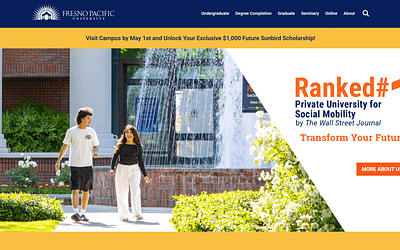
What does authentic higher education diversity marketing look like? See how Fresno Pacific serves diverse, first-gen students with mission-driven strategy.