
Personal Branding for Higher Ed Leaders
Learn how personal branding for higher ed leaders can strengthen institutional trust, expand reach on LinkedIn, and build stronger connections with key audiences.


Branding
Enrollment-driven marketing is the shift many institutions must make when traditional higher ed marketing strategy focused on brand awareness fails to produce measurable higher education enrollment growth.
If you’ve been in higher education marketing long enough, you’ve likely heard this phrase:
“If more people just knew about us, enrollment would grow.”
It sounds logical. It feels right. And in many board rooms and cabinet meetings, brand awareness becomes the rallying cry.
But what if awareness isn’t the problem?
 In this episode of The Higher Ed Marketer podcast, I sat down with Dr. Stacey Berggren, Vice President for Enrollment Management and Marketing at Northwest Nazarene University, live from the CCCU International Forum.
What she shared was not theoretical. It was hard-earned leadership insight from navigating real enrollment decline and making the bold organizational shifts required to fix it.
This is the story of what happens when you move from brand awareness marketing to enrollment-driven marketing.
Northwest Nazarene University had invested heavily in brand visibility.
Billboards. Wrapped buses. Airport placements. Mall signage.
On the surface, it looked impressive. The campus community could see the brand everywhere.
But enrollment didn’t move.
Stacey described a common dynamic in higher education marketing with creative teams pouring energy into elevating the brand, believing that if people simply knew the institution existed, they would show up.
But there’s a problem with that. Brand awareness without a call to action is just decoration.
As Stacey explained, there was a belief that the brand itself would be so compelling that students wouldn’t need a direct invitation.
But enrollment doesn’t grow on inspiration alone. It grows on invitation, urgency, clarity, and follow-through.
The shift required wasn’t cosmetic. It was philosophical.
At the time of the enrollment decline, marketing did not report to enrollment. It lived under advancement. That meant marketing was being pulled in multiple directions — fundraising, reputation management, storytelling — but not directly accountable for enrollment growth.
After an external assessment, leadership made a significant change: marketing moved under enrollment.
That decision altered everything.
This wasn’t about turf. It was about alignment.
To what end are we doing this?
If the end goal is enrollment growth, then strategy, structure, budget allocation, and team roles must reflect that.
Stacey didn’t just inherit marketing. She restructured it.
She evaluated every position. Every job description. Every skill gap. She asked hard questions:
This is where many institutions get stuck. They move boxes on an org chart but don’t rebuild the engine.

Enrollment-driven marketing doesn’t eliminate brand. It refines it and then it leverages the competitive differentiators of your brand.
It insists that every brand expression answer the question: “What do you want the prospective student to do next?”
Without a call to action, marketing becomes institutional decoration.
There was no digital advertising strategy in place for adult and graduate programs, even though those audiences rely heavily on digital channels to enter the funnel.
Recruitment-focused messaging was limited, meaning marketing efforts weren’t consistently guiding prospective students toward clear next steps.
While the team was producing strong storytelling content, it often lacked compelling calls to action that would move students further along in the enrollment process.
On top of that, the website infrastructure wasn’t optimized for SEO or conversion, making it difficult to capitalize on any marketing momentum they were generating.
She recognized that you can pour money into digital ads, but if the website isn’t built to convert, you’re wasting resources.
This is where enrollment-driven marketing becomes both strategic and technical.
It demands clear conversion paths that guide prospective students toward specific next steps, whether that’s visiting campus, starting an application, or requesting more information.
Also, it relies on digital advertising efforts that are measurable and tied directly to ROI, ensuring that budget decisions are grounded in data rather than assumptions.
A strong SEO strategy must be in place so that prospective students can actually find your institution when they search, and content must be intentionally crafted to move students through the enrollment funnel rather than simply tell inspiring stories.
Urgency messaging plays a critical role in prompting action, while coordinated social media efforts must align with recruitment objectives instead of operating as standalone storytelling platforms.
This is not an either/or issue. It’s an alignment issue.
The assessment is the easy part.
The hard part is the two to three years of execution afterward.
Stacey shared that she developed a multi-year action plan after the assessment. But when she presented it to her team, their response was honest:
“We can’t do all of this.”
So they prioritized.
What moves enrollment next fall?
What can wait?
What is essential?
What is just nice to have?
That prioritization process is one of the most important leadership skills in enrollment growth.
Because while everyone agrees enrollment matters, not everyone agrees on what should be sacrificed to achieve it.
At the same time, Stacey faced staffing reductions — moving from 11 marketing team members down to eight. That meant restructuring with fewer resources.
Which leads to another key insight that Stacey shared.
Enrollment decline doesn’t pause while you rebuild your team.
Sometimes you need immediate movement.
Stacey made a strategic decision to outsource certain functions rather than wait to build internal capacity. She framed it this way:
Enrollment-driven marketing isn’t about doing everything yourself. It’s about doing the right things at the right time.
That requires humility and courage.

One of the most compelling parts of our conversation was Stacey’s vulnerability about leading change inside a cabinet.
Enrollment VPs often have line of sight into problems. Convincing peers is another story.
She described bringing in external voices not just for insight, but for credibility.
“I need another trusted voice to confirm what we’re seeing.”
That’s not weakness.
That’s strategic leadership.
When marketing moved under enrollment at Northwest Nazarene University, Stacey knew a reporting change alone wouldn’t fix the problem.
As she explained, there had been “a real distinct sense of the call to action was admissions’ responsibility and not marketing’s responsibility” — so she had to clarify ownership and reset expectations.
She gathered her team and asked foundational questions about purpose, reminding them their role “isn’t just to make a pretty brand”, but to support enrollment outcomes.
The shift also required cabinet-level influence.
Stacey admitted that even when she had “clear line of sight into what we need to do,” persuading peers could be difficult.
Ultimately, she chose to focus on what truly mattered, saying she “tried to really focus on ‘What grows our enrollment?’ And then just do those things.”
This wasn’t just structural change. It was a disciplined cultural reset around enrollment growth.
One of the things I admire about Stacey’s leadership is her commitment to building teams that understand the “why” behind their work.
When she hired a new director of marketing, she didn’t start with projects.
She started with purpose.
Why are you here? What are we trying to accomplish? How does your work grow enrollment?
As she put it so clearly:
“We started up at ‘Why are you here? What are you trying to do for the university?’ and it isn’t just to make a pretty brand. To what end are we doing that?”
That line should be printed and posted in every marketing office.
Enrollment-driven marketing doesn’t eliminate creativity. Rather, it sharpens, directs, and aligns it.
As we wrapped our conversation, I asked Stacey what advice she would give to leaders facing similar challenges.
Her answer was both practical and profound.
First, she strongly believes marketing and enrollment should be paired structurally and, ideally, physically.
Second, she encouraged leaders not to isolate themselves.
The market is changing. Students are changing. Technology is changing.
No one knows it all, which makes collaboration all the more important.
“Don’t isolate yourself… You will never know it all and it is so quickly changing, and it’s not just the marketing that’s changing, but the customers changing.”
Enrollment-driven marketing requires outside perspective and ongoing evaluation.
It’s not a one-time fix. It’s a discipline.
Brand awareness matters. It builds recognition, shapes perception, and reinforces identity. But awareness alone does not produce enrollment growth.
Growth comes from alignment between marketing and enrollment.
It comes from clear calls to action, strong digital execution, disciplined prioritization, and the courage to restructure when necessary.
More than that, it comes from leaders willing to ask hard questions, invite outside perspective, and ensure every campaign serves a measurable purpose.
If your institution is facing enrollment decline — or if your marketing investment isn’t delivering meaningful ROI — the real issue may not be how polished your brand appears.
The deeper question is this: Is your marketing truly enrollment-driven?
For even more insights from Dr. Stacey Berggren, listen to the full episode on The Higher Ed Marketer podcast.
Turn Your Story into Enrollment Growth
You can’t build enrollment-driven marketing without intentional content.
As Stacey’s story shows, storytelling alone isn’t enough. Beautiful brand narratives, inspiring student features, and polished campus videos won’t move the needle unless they are strategically designed to guide prospective students toward action.
That’s where our Content Strategy and Marketing service comes in.
At Caylor Solutions, we help institutions create and distribute valuable, relevant, and consistent content that attracts and retains a clearly defined audience and moves them through the enrollment funnel.
When content is aligned with enrollment strategy, it becomes more than storytelling, it becomes a growth engine.
If your institution is ready to move from random acts of content to strategic, enrollment-driven marketing, we’re ready to help.
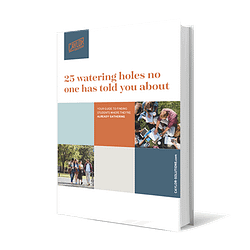
Then it’s time to look beyond the same crowded marketing channels everyone else is using. That’s why we want to share our new ebook: 25 Watering Holes No One Has Told You About. 
With this practical guide, you’ll discover how to:
In short, you’ll gain a fresh roadmap for connecting with the right students—long before they ever fill out an application. Download your free ebook today!




Subscribe to The Higher Ed Marketer podcast today!
Learn how personal branding for higher ed leaders can strengthen institutional trust, expand reach on LinkedIn, and build stronger connections with key audiences.

Mission-fit adult enrollment starts with clarity, relevance, and trust. Learn how to reach adult and graduate students more effectively.

Small colleges can’t afford to waste budget. Learn how to build brand awareness organically—by prioritizing lead generation and smart content.