
Trust in Higher Education Marketing: The New Enrollment Strategy
Build trust in higher education marketing with authentic stories, clear outcomes, and consistent messaging that helps prospective students confidently choose your institution.


Marketing Strategies
Protecting your institution’s higher ed digital marketing ROI requires a clear-eyed look at the data, specifically the true cost per student enrollment that often hides behind flashy but expensive digital campaigns.
As a college president or cabinet member, you are likely used to seeing large numbers.
You see the multi-million dollar endowments, the construction costs for the new student center, and the total tuition revenue.
But what if I told you that while you were reading this sentence, your institution might have just spent $1,200 on a single mouse click?
It sounds like a typo. It sounds like a glitch in the matrix. But as I share in my new book, Know What You Don’t Know, this was a real-world scenario for a small liberal arts college I consulted with.
That one click wasn’t just an anomaly; it was a symptom of a fundamental misunderstanding of the difference between marketing vs advertising in higher education.
And for many institutions, this misunderstanding is costing them their future.
In the world of digital advertising, “The $1,200 Keyword” is the ultimate cautionary tale.
This institution was bidding on a high-competition, broad-match keyword. They were “winning” the bid, but they were losing the war.
When we did the math, the numbers were staggering:
When you follow that math to its logical conclusion, the Cost Per Acquisition (CPA)—the amount of higher education ad spend required to get just one student in a seat—was $288,000.
Unless your tuition is $300,000 per year, that is not an investment. It’s a bankruptcy strategy.
Why does this happen?
When enrollment numbers dip, the most common executive reflex is to increase the advertising budget.
We assume that if we just buy more attention, we will eventually find the students we need.
But attention is just a faucet.
Your institutional infrastructure—the student journey from first click to first day of class—is the bucket.
If your institution is currently struggling with its “Yield Trap”—where you are attracting interest but failing to convert it—simply turning the faucet on higher will only waste more water.

In many cases, a $1,200 click isn’t a “marketing” failure; it’s a structural one.
If your academic programs are no longer aligned with student demand, or if your net price is perceived as too high for the value you offer, no amount of advertising can “fix” that.
You are paying a premium to advertise a product the market isn’t buying.
There is a psychological trap at play here that I often call the “Vanity Drug.”
It is the desire to see big numbers on a report—thousands of impressions, tens of thousands of clicks, and a “busy” dashboard.
Executives often feel better when they see high traffic volumes because it feels like progress.
However, high-volume, broad-match keywords (like “Online MBA” or “Nursing Degree”) are the most expensive way to improve your higher ed digital marketing ROI.
You are competing with every massive state school and well-funded for-profit institution in the country for those terms.
A mission-fit student isn’t just looking for “a degree.” They are looking for your degree.
They are looking for the specific culture, outcomes, and community that only your institution provides.
When you pivot your higher education ad spend away from broad “volume” terms and toward specific “long-tail” keywords that reflect your unique mission, two things happen:
True leadership requires looking at the “faucet” and the “bucket” simultaneously:
The Product: Does our program mix match current market demand?
The Price: Is our value proposition clear, or are we being “discounted” out of the conversation?
The Promotion: Are we paying for broad, expensive clicks, or are we targeting the specific “mission-fit” students who are likely to enroll?
You don’t need to be a digital ads expert to lead your team effectively.
You just need enough marketing literacy to ask the right questions during your next cabinet meeting to ensure a healthy higher ed digital marketing ROI.
If your team is reporting on “impressions” or “clicks,” they are giving you vanity metrics.
To protect your institution’s budget and lower the cost per student enrollment, you need to dig deeper into your enrollment marketing KPIs:
The $1,200 click is a wake-up call. It’s a reminder that in a time of enrollment cliffs and tightening budgets, we cannot afford to outsource our understanding of how our institutions are being found.
In Chapter 6 of my book, Know What You Don’t Know, I dive deep into the “Vicious Cycle” of digital marketing and provide the framework you need to identify your true KPIs.
Being a good steward of your institution means knowing enough to ask the questions that stop the waste and start the growth.
Ready to stop the “vicious cycle” of wasteful spending?
Today’s higher education landscape is louder and more complex than ever before.
You don’t need to become a marketing expert to lead your team with confidence, but you can no longer afford to stay on the sidelines.
My new book, Know What You Don’t Know: What Every Higher Ed Leader Needs to Understand About Marketing, was written to be your essential field guide. In it, I share decades of real-world insight to help you:
Stop the “vicious cycle” of wasteful spending and start leading with clarity.
Get your copy of Know What You Don’t Know today and strengthen your ability to lead with insight, alignment, and confidence. Reach out if we can help!
The essential marketing book every higher education institution needs! If you are a higher education marketing professional seeking a fail-safe plan to make your institution stand out, “Chasing Mission Fit” is your guide.
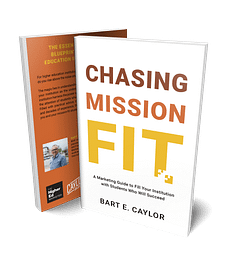 Discover how to:
So you can empower your institution with audience-focused marketing strategies, and attract mission-fit students who will flourish in your unique academic environment.
Ready to transform your institution’s marketing approach?
Order now!
images via chatgpt



Subscribe to The Higher Ed Marketer podcast today!
Build trust in higher education marketing with authentic stories, clear outcomes, and consistent messaging that helps prospective students confidently choose your institution.

Learn how peer-to-peer student recruitment builds trust, strengthens outreach, and helps prospects make confident college decisions.
Rethink your higher education press release strategy with newsroom-style storytelling that earns media attention, strengthens reputation, and supports enrollment.