
Why We Need to Improve Higher Ed Creative Operations
Improve higher ed creative operations with practical strategies for protecting creative time, streamlining workflows, and supporting stronger teams.


social media
Social Media Search Optimization is quickly becoming one of the most important strategies in higher education marketing.
And yet, most colleges are still using social media like it’s 2015.
Posting consistently. Tracking likes. Celebrating follower growth.
All while everyone’s quietly wondering:
Is any of this actually driving enrollment?
If your team feels stretched thin trying to “keep up” on social media without clear evidence that it’s producing inquiries or applications, you’re not alone.
The problem isn’t effort. It’s alignment.
And if we treat it more like the search engine that it’s become, it becomes one of the most powerful enrollment tools available.
What is Social Media Search Optimization?
Social Media Search Optimization is the practice of structuring social content so it can be discovered through platform search, Google results, and AI-generated summaries—while guiding prospective students toward clear next steps.
For colleges, that means:
Many institutions are still measuring the wrong things.
Engagement is easy to track. Conversions take more intention. A post with 500 likes feels successful.
But if it didn’t generate a single inquiry, was it effective?
This is the same tension we explored in Brand Awareness on a Budget.
Visibility alone doesn’t pay the bills. Enrollment does.
Are we creating content that students search for… or content we simply hope they’ll notice?
Today’s students use:
If your content isn’t structured for discovery, you’re invisible in the moments that matter most.

I’m not the only one seeing this shift.
Gary Vaynerchuk argues that we have entered the age of “interest media,” where algorithms prioritize individual pieces of content based on relevance rather than your total follower count.
This is a massive win for small colleges.
You don’t need a million followers to go viral; you just need to be relevant to the right 500 students who are searching for what you uniquely offer.
This “relevance warfare,” as he calls it, means your unpolished, authentic content can outperform a massive university’s high-budget production if it directly answers a searcher’s query.
For more trends that Gary V is predicting, see my post here.
Before we talk tactics, we need to talk alignment.
At Caylor Solutions, we focus on mission-fit students. Not just more students.
The goal of social media search optimization isn’t to go viral.
It’s to be findable by the right students asking the right questions.
Gen Z doesn’t want polished campaigns. They want clarity.
As we discussed in How to Market to Gen Z, authenticity outperforms perfection.
Instead of generic “campus life” posts, try:
These are searchable questions.
And when your captions, video scripts, and descriptions use that language naturally, your content becomes discoverable.
That’s social media search optimization.
Search behavior signals intent.
If a student searches, “Is a small Christian college worth it?” they’re already evaluating.
Your job isn’t to impress them. It’s to answer them.
Clear.
Honest.
Human.
Trust reduces friction. And reduced friction increases conversion.
Social media only powers enrollment when it connects to a system.
Here’s the framework we recommend:
Without steps 4 and 5, social media becomes entertainment.
But with them, it becomes strategy.

AI is changing how content is created and discovered. But it doesn’t replace strategy.
It exposes weak strategy.
Generative AI tools reward clarity and structure.
The same is true for social.
AI can help your team:
Social media search optimization doesn’t require more content.
It requires smarter structure.
AI simply helps you execute that structure efficiently.
If Social Media Search Optimization is done correctly, your metrics shift.
Instead of celebrating:
You begin tracking:
These metrics tie directly to enrollment health.
And they provide clarity to presidents and boards who want to know what marketing is actually doing.
The institutions that win in the next five years won’t necessarily post more.
The colleges that thrive will stop chasing visibility for its own sake.
Instead, they will answer the questions students are already asking and make the next step obvious.
AI will be used to increase clarity and consistency—without sacrificing voice.
Social media search optimization is not a trend.
It’s a strategic shift in how students discover, evaluate, and choose institutions.
If your social media feels busy but not productive, this is your invitation to rethink the framework—not just the frequency.
Ready to Turn Social Media Search Optimization into Enrollment Growth?
If your team is posting consistently but still unsure how social media connects to real enrollment outcomes, it may be time for a clearer strategy.
We build structured, search-optimized frameworks that guide students from discovery to inquiry, connect posts to landing pages and CRM systems, and measure what truly matters: visits, applications, and yield.
You don’t need more content.
You need content with direction.
If you’re ready to move from activity to alignment, let’s build a social media strategy that actually powers conversions.
The essential marketing book every higher education institution needs! If you are a higher education marketing professional seeking a fail-safe plan to make your institution stand out, “Chasing Mission Fit” is your guide.
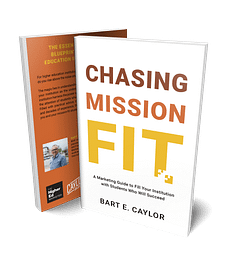 Discover how to:
So you can empower your institution with audience-focused marketing strategies, and attract mission-fit students who will flourish in your unique academic environment.
Ready to transform your institution’s marketing approach?
Order now!
images via chatgpt


Subscribe to The Higher Ed Marketer podcast today!
Improve higher ed creative operations with practical strategies for protecting creative time, streamlining workflows, and supporting stronger teams.

AI enrollment reporting helps colleges find trends, reduce reporting overload, and make better decisions without replacing human judgment.

Learn how personal branding for higher ed leaders can strengthen institutional trust, expand reach on LinkedIn, and build stronger connections with key audiences.