
Beyond Email: How Peer-to-Peer Student Recruitment Builds Enrollment Confidence
Learn how peer-to-peer student recruitment builds trust, strengthens outreach, and helps prospects make confident college decisions.


Branding
Trust in higher education marketing has always been essential to an effective enrollment marketing strategy, but today it must begin long before a prospective student is ready to apply.
It has to begin much earlier.
Prospective students are encountering colleges through social media, digital ads, billboards, high school kiosks, search engines, AI tools, campus events, family conversations, and word of mouth. Every one of those touchpoints either strengthens confidence in your institution or creates another reason for a student to hesitate.
That is why trust in higher education marketing has become more than a branding consideration. It is an enrollment strategy.
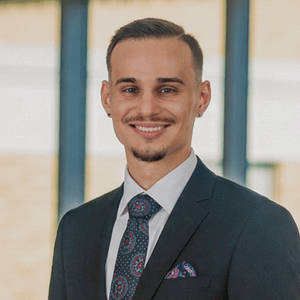 In this episode of The Higher Ed Marketer, I spoke with Derek Riordan, Digital Marketing Strategist at Southeast Missouri State University. Derek brings an especially valuable perspective to this conversation because he markets the same institution he attended as a nontraditional student, Air Force veteran, and young father.
His experience taught him that students are not simply evaluating majors, tuition, or campus amenities. They are asking deeper questions:
Derek’s answer to all of these questions comes back to one word: trust.
“Universities in higher education need to be based in trust because right now there’s a lot of uncertainty. And with all this new technology coming out, like AI, the search journey is changing quite significantly. So we really need to be intentional with doubling down and being about what we’re messaging these students.”
That is the challenge for every enrollment marketer today.
We are not merely trying to capture attention. We are trying to earn enough confidence for a student and family to take the next step.
A lot of enrollment marketing is organized around immediate action.
Apply now.
Schedule a visit.
Submit your deposit.
Complete your FAFSA.
Those calls to action matter, but they come relatively late in the student enrollment decision journey. Before students are ready to act, they are gathering impressions. They are deciding which institutions feel familiar, credible, accessible, and relevant.
That early period is where higher education brand trust begins.
Derek described early brand influence as meeting students where they already are. That means maintaining an intentional presence across paid and organic social media, traditional advertising, community involvement, events, and school-based platforms.
The key is not to treat those channels as disconnected campaigns.
Imagine a student seeing a Southeast Missouri State University billboard while riding through town. Later that day, the same student encounters a digital ad from SEMO after entering a geofenced area. The next week, that student sees the university represented in school or at a community event.
Recognition creates familiarity.
Familiarity creates confidence.
And confidence can eventually become action.
This is where enrollment teams sometimes struggle with attribution.
We want a clean line from an ad impression to an application. But students do not experience our marketing in a clean, linear sequence.
They move between offline and online environments, talk with parents and friends, revisit websites, watch videos, ask AI tools for recommendations, and gradually form an opinion.
Trust is often built through accumulated experiences rather than one decisive click.
Derek and his team also think carefully about when to introduce each message. During one portion of the year, the goal may be to build a warm audience and generate interest. Later, the message may shift toward campus visits. When the application opens, the call to action becomes more direct.
That is an important reminder: a strong enrollment marketing strategy does not ask every student to do the same thing at the same time.
The message should match the student’s level of readiness.
Early awareness is valuable, but awareness alone is not enough. Every channel must work together to move students toward a meaningful next step.
Derek discussed several ways SEMO is connecting those experiences, including digital platforms, traditional advertising, NextGrad kiosks in schools, lead-generation campaigns, application campaigns, and a strong emphasis on campus visits.
That last point deserves special attention.
A prospective student’s campus visit can be one of the most important moments in the entire enrollment process. It gives students and families the opportunity to test the promise for themselves.
A campus visit can turn an abstract brand into a lived experience. But that only works when the visit confirms the expectations that marketing has created.
Enrollment, admissions, student affairs, academic departments, faculty, financial aid, and campus leadership all have a role in delivering the promise.
Marketing may bring students to the door, but the institution must prove that the message is true.
The same principle applies before the visit. Your digital ads, website, email communications, organic social content, and high school outreach should feel like pieces of one story.
A student should not see one promise on Instagram, a completely different message on a landing page, and a third institutional personality when they arrive on campus.
Consistency reduces uncertainty.
And reducing uncertainty is one of the clearest ways to build trust.

The college search process is changing quickly because students are increasingly asking AI tools to help them explore institutions.
Instead of searching only for a school name or academic program, students can now ask complex, conversational questions:
These are not simple keyword searches. They are questions about fit, value, experience, and trust.
That means colleges need content that answers specific questions with clarity.
Derek emphasized that AI tools need credible material to draw from. If an institution does not clearly publish its outcomes, support services, student experiences, program details, and distinctive strengths, it may be left out of the answer entirely.
Institutions need:
Derek also made an important distinction between using AI to improve efficiency and allowing it to replace the human voice.
“AI can help me work faster. But it cannot tell a story that only a real advisor can. So I think that we need to be really intentional with how we’re using AI, and we should look at it as a tool to free up our time so we can further build and nurture the relationship with the prospective students we’re trying to reach.”
That should be a guiding principle for every higher education marketing team.
AI can help organize information, generate ideas, analyze data, adapt content, and accelerate routine work. But it cannot replace the credibility of a student describing how a professor supported them, an advisor answering a difficult question, or an employer explaining why they value graduates from your institution.
The strongest approach is human, AI, human.
Use the technology to help your team work more effectively. Then apply human judgment, institutional knowledge, empathy, and storytelling before the message reaches a student.
AI should create more capacity for relationships—not less humanity in your communication.

Trust becomes especially important when families begin evaluating the return on their investment.
Students and parents may both care about outcomes, but they often approach the decision from different perspectives.
A prospective student may be thinking about belonging, independence, academic interests, friendships, campus life, and future possibilities.
A parent may be focused on affordability, debt, graduation, employment, safety, support systems, and long-term value.
Derek explained that SEMO uses institutional research and data-based outcomes to shape its marketing. The team also seeks testimonials from employers who have hired SEMO graduates, giving outside voices an opportunity to validate the institution’s promise.
That employer perspective can be powerful.
When a company explains that SEMO graduates arrive with practical experience, professional skills, and the ability to contribute, the institution gains more than a testimonial. It gains social proof.
SEMO can then use those stories strategically, including in geographic areas where the employer is well known. The message becomes more relevant because the audience recognizes the company and understands its value within the region.
But numbers and employer validation are only part of the story.
“We should talk about the outcomes, but we should also not reduce these students to numbers. The numbers matter, but the story behind the numbers is what makes people believe in them.
However, again, when we’re talking about making content that is readable to these machines, I think what goes into that a lot of times is how the content is structured.
So, you know, you can have a good story, but you just need to be really intentional with putting SEO into that story and basically optimizing it to that schema without taking away from the overall story of what you are trying to articulate.”
That balance is critical.
Data creates credibility. Stories create meaning.
A placement percentage may interest a parent, but the story of a graduate finding meaningful work helps the family understand what that number could mean for their student.
An affordability statistic may earn attention, but the experience of a veteran using available resources and receiving personalized guidance makes support feel real.
An internship total may demonstrate scale, but a student explaining how an internship shaped their confidence and career direction gives the result emotional weight.
The best outcome marketing brings the quantitative and qualitative evidence together.
Trust cannot be created through messaging alone.
At some point, the student experiences the institution directly. When that happens, every claim becomes testable.
Derek shared that SEMO’s promise of being “boldly supportive” was not merely a phrase he encountered in marketing. He experienced it personally as a nontraditional student, veteran, and young father. Professors and support services helped him navigate the journey and reinforced his belief that he could succeed.
That is what makes a brand promise credible.
“Authenticity is key here. [I went to] college here as an undergrad and I was a nontraditional student. At the time I was a young father, and one of SEMO’s core values that was sold to me was that you are boldly supported.
And I truly felt that through my professors there. With that being said, they supported me throughout this whole journey. And they basically showed me that, ‘Hey, you can achieve this because we’re here to help you and we’re in your corner.’”
There is a powerful lesson here for every institution.
Do not make a promise your campus cannot deliver.
A polished campaign may generate interest, but if the student experience contradicts the message, retention will suffer. Students will recognize the gap. Parents will recognize it. And in a world of online reviews, social media, group chats, and AI-generated summaries, future prospects may discover it too.
It is aligning what you say with what students experience.
That means higher education marketers should regularly ask:
When the answers are yes, marketing becomes more than promotion. It becomes an honest invitation.

We often talk about platforms, campaigns, conversion rates, cost per click, creative performance, search visibility, and applications.
All of those things matter.
But underneath every metric is a student deciding whether your institution is worthy of their confidence.
Trust influences whether they notice your message, explore your website, believe your outcomes, schedule a visit, complete an application, submit a deposit, and remain enrolled after they arrive.
Show up consistently across the channels students use.
Answer the specific questions they are asking. Use AI to create capacity without sacrificing your human voice. Support your claims with data. Bring those outcomes to life through student, alumni, and employer stories.
Most importantly, make sure your campus delivers the promise your marketing makes.
That is how trust in higher education marketing becomes enrollment momentum.
For even more insights from Derek Riordan, listen to the full episode on The Higher Ed Marketer podcast.
At Caylor Solutions, we help colleges and universities turn their institutional strengths into clear, credible enrollment marketing strategies. From audience research and brand messaging to digital campaigns, websites, content, and student-centered storytelling, we can help your institution communicate a promise that students understand—and an experience your campus can deliver.
Let’s build an enrollment strategy that earns attention, strengthens confidence, and moves mission-fit students toward action.
Contact us today to learn more.
The essential marketing book every higher education institution needs! If you are a higher education marketing professional seeking a fail-safe plan to make your institution stand out, “Chasing Mission Fit” is your guide.
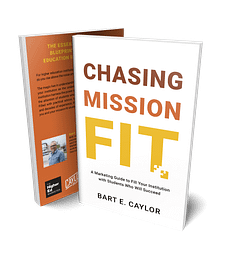 Discover how to:
So you can empower your institution with audience-focused marketing strategies, and attract mission-fit students who will flourish in your unique academic environment.
Ready to transform your institution’s marketing approach?
Order now!



Subscribe to The Higher Ed Marketer podcast today!
Learn how peer-to-peer student recruitment builds trust, strengthens outreach, and helps prospects make confident college decisions.
Rethink your higher education press release strategy with newsroom-style storytelling that earns media attention, strengthens reputation, and supports enrollment.

Build alumni advocacy for recruitment through mentoring, speaking, events, and relationships before financial asks.