
Personal Branding for Higher Ed Leaders
Learn how personal branding for higher ed leaders can strengthen institutional trust, expand reach on LinkedIn, and build stronger connections with key audiences.


Branding
If you want a higher education storytelling strategy that actually drives enrollment, you have to start by telling better, more authentic stories.
Sounds simple, but it’s a lot harder to pull off in reality.
If you’ve ever sat in a marketing meeting and felt like you were drowning in requests—emails, landing pages, campaigns, social posts—you’re not alone.
And if you’ve ever wondered, “Are we actually telling the right stories?”—you’re asking the right question.
In this episode of The Higher Ed Marketer podcast, I had the chance to talk with Julia Ferrante of Middlebury College and Rachel Colquitt of South Piedmont Community College.
Beyond their titles what really stood out was their shared origin story. They both started in journalism.
And that foundation? It’s exactly what makes their approach to higher education storytelling strategy so effective.
Because at the end of the day, the institutions that win aren’t the ones with the most content.
They’re the ones telling the most meaningful stories.
Let’s start here: storytelling isn’t a deliverable.
It’s not a blog post, a video, or a campaign. It’s a strategy.
Rachel put it in a way that should make every higher ed marketer pause:
“Every interview that we conduct with a student, every student story we post is a piece of qualitative research… I try to root everything that we’re doing in what we’re actually hearing from the students.”
That’s the shift.
A strong higher education storytelling strategy centers on uncovering what’s real.
It means understanding why students choose your institution, what they experience once they arrive, and how their lives are ultimately changed because of it.
Too often, institutions skip this step and jump straight to messaging frameworks. But if the story isn’t grounded in truth, it won’t resonate.
And your audience will know.
It’s something I’ve said before, and it came through again in this conversation…
Hire journalists!
Julia and Rachel both reinforced that idea in this conversation. Journalism teaches you something that’s incredibly rare (and incredibly valuable) in higher ed marketing:
How to ask better questions.
Rachel explained it this way:
“There’s a lot of incredibly smart people, but sometimes there’s really obvious questions that have not been asked… if you have that question, a lot of people have that question.”
That mindset is incredibly valuable in higher ed, where teams can easily become immersed in their own way of thinking and seeing things.
Higher ed has a tendency to operate in silos. We develop language, processes, and assumptions that make perfect sense internally but fall flat externally.
A strong higher education storytelling strategy requires stepping outside those silos and asking:
Journalists are trained to challenge assumptions. And that’s exactly what higher ed marketing teams need.
The ability to pause, question, and reframe is what separates effective storytelling from noise.
One of the most practical takeaways from this episode is how Rachel reframed storytelling.
Instead of being something tied to a campaign, a season, or a specific initiative, she described it as ongoing, daily research.
Each conversation with a student becomes a source of data. Interviews turn into insight. Stories serve as evidence of what’s really happening on campus.
That shift changes how you approach the work entirely.

This is where a higher education storytelling strategy becomes a true competitive advantage.
While some institutions are still guessing what matters most, others are actively listening, and the ones who listen better ultimately tell better stories.
No conversation about storytelling today is complete without acknowledging the role of AI.
It’s changing how we work, how we produce content, and how quickly we can move. But even with all of that progress, something essential remains unchanged.
Rachel captured it clearly:
“Technology is great, but we are still human beings and this is very much a human business and don’t lose that.”
That tension is real. AI can support the process, but it can’t replace the depth of lived experience or the nuance of a real conversation.
The stories that resonate most in higher education are rooted in human moments—uncertainty, growth, transformation, and connection.
Those elements come from listening, observing, and engaging directly with students and faculty.
Technology can help amplify those stories, but it can’t create them in a meaningful way on its own.
One of the biggest challenges in higher ed marketing is managing complexity.
With so many audiences, programs, and priorities, it’s easy to feel like every message needs to do everything at once.
But clarity often comes from restraint.
 Julia talked about the importance of focusing on a few core ideas—the essence of what makes an institution distinct—and building from there.
That approach allows storytelling to stay connected to mission.
Instead of trying to communicate everything, institutions can focus on what matters most and reinforce it consistently.
Over time, those stories begin to shape perception in a much more meaningful way than broad, all-encompassing messaging ever could.
Your higher education storytelling strategy should reflect that.
Not every story needs to say everything.
But every story should reinforce something essential.
Most institutions don’t have a shortage of stories.
What’s often missing is a consistent way of uncovering and sharing them.
Rachel described how her team has worked to create that momentum by encouraging faculty, staff, and students to contribute their experiences.
That kind of culture doesn’t happen automatically. It takes intention and persistence.
When storytelling becomes part of the everyday rhythm of an institution, it stops feeling like an extra task and starts becoming a shared responsibility.
Over time, that shift makes it easier to capture authentic moments and turn them into meaningful narratives that reflect the true student experience.
One of the most practical insights from this conversation was Rachel’s reminder to “market the marketing.”
The impact of storytelling isn’t always immediately visible, which makes it easy for others on campus to underestimate its value.
A student story doesn’t always translate directly into an enrollment deposit the next day. A brand video doesn’t show up neatly in a report labeled “this drove 47 applications.”
But that doesn’t mean the impact isn’t there.
It just means we have to be more intentional about connecting the dots.
When a student feature is published, where does it go next? Does it get used in admissions emails, on program pages, in social campaigns, or in recruiter conversations?
The more integrated storytelling becomes, the easier it is to see how it contributes to engagement at multiple points along the journey.
Story-driven content often shows its value through increased time on page, higher engagement rates, more shares, and stronger click-throughs.
Those signals tell you something important: people are paying attention, and they’re connecting with what you’re putting in front of them.
Over time, those moments of connection build familiarity and trust—two things that are incredibly difficult to measure in isolation, but essential when a student is deciding where to apply or enroll.
When prospective students reference a story they read, a video they watched, or a social post that resonated with them, that feedback needs to be captured and shared.
Those anecdotes, when paired with data, become powerful proof points.
And then there’s the internal piece.
That means reporting not just on outputs—how many stories were published—but on outcomes: how those stories performed, where they were used, and what they influenced.
When teams take the time to connect storytelling to engagement, perception, and enrollment activity, it reframes marketing as a strategic function rather than a support role.
Telling that story internally builds trust.
It gives stakeholders a clearer understanding of why storytelling matters. And over time, it creates the kind of alignment that allows storytelling to scale across the institution.
Because when people see the impact, they’re far more likely to invest in the work.
If there’s one thing I hope you take away from this episode, it’s this:
Storytelling isn’t extra, or “fluff” pieces. It is the work of marketing.
Your higher education storytelling strategy is the bridge between your mission and your audience.
It brings clarity to complexity and turns information into something people actually care about.
When every institution has access to the same tools and platforms, what sets you apart is the story you tell and how truthfully you tell it.
For even more insights from Rachel and Julia, listen to the full episode on The Higher Ed Marketer podcast.
Let’s Build Your Story Strategy
Most institutions aren’t lacking stories.
They’re lacking a strategy to turn those stories into momentum.
At Caylor Solutions, we help higher ed teams move beyond content creation and build a higher education storytelling strategy that actually drives enrollment, strengthens brand voice, and connects with students in a meaningful way.
Because when your story is clear, consistent, and grounded in what’s real, it doesn’t just sound better—it performs better.
If you’re ready to:
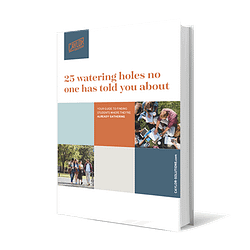
Then it’s time to look beyond the same crowded marketing channels everyone else is using. That’s why we want to share our new ebook: 25 Watering Holes No One Has Told You About. 
With this practical guide, you’ll discover how to:
In short, you’ll gain a fresh roadmap for connecting with the right students—long before they ever fill out an application. Download your free ebook today!
Images via chatgpt



Subscribe to The Higher Ed Marketer podcast today!
Learn how personal branding for higher ed leaders can strengthen institutional trust, expand reach on LinkedIn, and build stronger connections with key audiences.

Mission-fit adult enrollment starts with clarity, relevance, and trust. Learn how to reach adult and graduate students more effectively.

Small colleges can’t afford to waste budget. Learn how to build brand awareness organically—by prioritizing lead generation and smart content.