
Mission-Fit Marketing and Faculty Voice in Enrollment
Faculty voice in enrollment marketing builds trust, academic credibility, and stronger connections with mission-fit students.


Branding
AI and authenticity are top of mind for higher ed marketers today.
And it’s no wonder.
In an age where artificial intelligence can generate entire campaigns in seconds, the pressure to “keep up” can feel overwhelming, especially for small college marketing teams already stretched thin.
But for institutions built on mission, trust, and community, the promise of AI often comes with an uneasy question: What happens to our voice?
You’re not alone if you’re wondering whether using AI tools means compromising the very authenticity your institution is known for. In fact, recent research shows that more than half of consumers question whether AI-generated content can be trusted at all.
At the same time, declining enrollment, tighter budgets, and rising content demands are forcing higher ed marketers to work smarter—not just harder.
The good news is that you don’t have to choose between innovation and authenticity.
In this post, we’ll explore how colleges and universities can embrace the efficiency of AI while protecting, and even enhancing, their most valuable asset: a real, human story.
You’ll discover how AI can help your team scale its efforts, support your brand voice, and deepen your impact without losing what makes your message meaningful.
For many in higher ed, “AI” and “authenticity” feel like opposing forces.
It’s easy to assume that the more technology you introduce into your storytelling, the less human it becomes. That fear is valid, especially when generative tools can now write, design, and distribute content at lightning speed.
But AI is not really the problem. Misunderstanding the true strategic use of AI is.
When used strategically, AI doesn’t have to dilute your message. In fact, it can protect the margin your team needs to focus on the one thing AI can’t do: tell your story from the inside.
A: Colleges can use AI to enhance, not replace, their institutional story by automating repetitive tasks—like formatting emails or summarizing transcripts—while keeping human oversight on anything involving tone, brand voice, or mission messaging. AI supports scalability, but the message must still come from the heart of the institution.
Much of the public skepticism around AI stems from a growing inability to distinguish between real and synthetic content.
A recent Quirk’s study found that more than half of consumers are unsure whether the content they see online is genuine—and that uncertainty directly impacts their trust in a brand.
“Consumers expressed a high level of concern over the use of AI-generated imagery and content… More than half said they found it difficult to determine whether content was authentic.”
— Quirk’s Market Research
But AI doesn’t have to replace your creative voice—it can enhance it.
When you use AI to support, not substitute, your team’s work, you can actually create room for more human connection.

If your institution serves Gen Z and the emerging Gen Alpha audiences, authenticity isn’t optional—it’s a requirement.
According to Collegis Education, today’s students expect personalized, transparent communication from the schools they consider.
They want to know if your values align with theirs.
They want real stories from real students.
They want to feel seen.
That’s why AI must be deployed in ways that reinforce rather than replacing those values.
When your institution uses AI to surface more voices, repurpose more student stories, and respond more consistently to real questions, you’re not faking authenticity. You’re scaling it.
A: Yes—when used wisely, AI can help colleges share more student stories, repurpose alumni testimonials, and respond faster to inquiries, all while staying mission-aligned. It frees up teams to focus on deeper strategy and more meaningful content creation.
Adopting AI doesn’t mean abandoning your school’s identity.
When used with intentional guardrails, AI becomes a powerful amplifier for your message, not a substitute for it.
Here are three practical ways your college can use AI to strengthen your storytelling efforts while protecting authenticity.
AI excels at automating tasks that drain your team’s time and creativity.
Think: summarizing transcripts, turning blog posts into social copy, or drafting event descriptions for multiple platforms.
But the human element—the voice that reflects your institution’s values, culture, and tone—should remain in your team’s hands.
This approach echoes the guidance from University Business:
“Automating the tedious parts of content management… frees creative teams to focus on what technology can’t replicate: authentic storytelling.”
By delegating repetitive work to AI, your team gains breathing room to focus on the work only humans can do—crafting messages that resonate with mission-fit students and families.
One of the best uses of AI is in repurposing content.
You can feed a student testimonial or president’s message into a tool like ChatGPT and ask it to generate tailored copy for email, social, or landing pages.
Just remember: AI is a first draft partner, not a final decision maker.
Trust erodes when people can’t tell if something is real.
The solution? Keep a human editor (ideally someone trained in your brand voice) responsible for every AI-assisted piece of content that goes public.
That small step makes a big difference in preserving tone, clarity, and integrity.
AI can help you create more content but it can’t replicate the power of lived experience.
To keep your messaging authentic, use AI to support real voices, not overwrite them.
Pull student quotes from interviews and ask AI to reformat them into social media posts.
Use AI to organize and tag alumni testimonials for future campaigns.
But never lose sight of what matters most: the human stories that make your institution unique.
This is especially important for Gen Z audiences.
Young audiences crave relatability. They’re moved more by a shaky selfie video than a polished, brand-approved production.
Let AI extend the reach of these stories but let your community remain the voice.

How you use AI reflects on your institution’s values. That’s why ethical considerations aren’t optional. They’re foundational to the conversation around AI and authenticity.
Let’s look at two critical ways to ensure your AI use reinforces trust and aligns with your brand.
When prospective students or donors discover that a message they received was generated or assisted by AI, will they feel deceived or supported?
That depends entirely on your transparency.
If your audience can’t distinguish between genuine human insight and machine-generated filler, they may start questioning your message altogether.
To protect your institution’s credibility, consider what tactic would be best for your school:
When you use AI responsibly and disclose it appropriately, you build trust rather than compromise it.
Ethical use begins internally.
Without clear boundaries, even well-meaning teams can drift into over-reliance on AI tools or inadvertently create content that feels robotic or off-brand.
That’s why creating an AI content policy or “playbook” is essential.
It should define:
These policies help to preserve trust, consistency, and institutional identity as your team embraces new tools.
AI and authenticity don’t have to be at odds.
In fact, when used with intention, AI can help your team do more of what you’re already great at: telling a compelling, mission-driven story.
The key is remembering what your audience truly values—not just speed or polish, but honesty, relevance, and connection.
AI can help you scale that story. Repurpose it. Share it across platforms. But only you—your team, your leadership, your community—can ensure it stays true to who you are.
So yes, use AI. But don’t lose your voice in the process.
Because in a world full of content, what still cuts through the noise is a story told with heart.
A: Ethical AI use means being transparent about where AI is used, setting clear boundaries around its role, and ensuring that content aligns with the institution’s values and brand voice. It involves human editing, clear disclosure, and a commitment to maintaining trust with students, donors, and alumni.
Make AI Work Smarter for Your Enrollment Strategy
Authentic messaging starts with aligned systems.
If you’re thinking about how to integrate AI into your marketing efforts without losing your institutional voice, it’s time to take a closer look at the foundation: your enrollment strategy.
At Caylor Solutions, our Enrollment Assessment goes beyond surface-level audits.
We conduct an in-depth evaluation of your current admissions workflows, communication touchpoints, engagement methods, and retention tactics to uncover what’s working—and what’s not.
Whether you’re using AI tools or still exploring them, this assessment ensures your strategy is ready to support the kind of authentic, mission-aligned storytelling students expect.
If your enrollment strategy feels fragmented or reactive, AI will only multiply the noise.
But with the right strategy in place, AI becomes a tool for amplifying clarity rather than adding confusion.
Let’s make sure your enrollment foundation is ready for the future…
…without losing the authenticity that built your institution in the first place.
Reach out today to schedule your Enrollment Assessment.
The essential marketing book every higher education institution needs! If you are a higher education marketing professional seeking a fail-safe plan to make your institution stand out, “Chasing Mission Fit” is your guide.
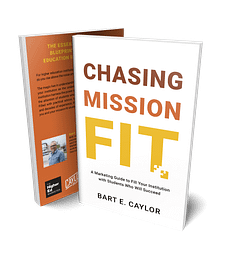 Discover how to:
So you can empower your institution with audience-focused marketing strategies, and attract mission-fit students who will flourish in your unique academic environment.
Ready to transform your institution’s marketing approach?
Order now!
Images via Midjourney


Subscribe to The Higher Ed Marketer podcast today!
Faculty voice in enrollment marketing builds trust, academic credibility, and stronger connections with mission-fit students.

Servant leadership in higher education starts with curiosity, empathy, alignment, and accountability. Greg Aden shares practical advice.

Build a mission-fit SEM strategy that aligns keywords, ads, and landing pages to attract right-fit students and reduce wasted spend.