“Knowing what you don’t know” is perhaps the most important realization higher ed leaders can have today. Turns out, what you don’t know can actually hurt you.
In my work with college and university leaders across the country, I often hear a common concern whispered behind closed doors: “I’m not sure I know enough about marketing to make the right decisions.”
Let me tell you, you’re not alone.
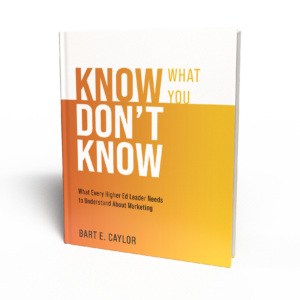
That’s exactly why I wrote my new book, Know What You Don’t Know: What Every Higher Ed Leader Needs to Understand About Marketing.
It’s for the president who didn’t come up through enrollment, the provost who inherited a website problem, and the cabinet member who keeps hearing buzzwords like SEO and AI but isn’t quite sure what to do next.
In this episode of The Higher Ed Marketer podcast, my team turned the mic around and put me in the hot seat to talk about why this book matters now, what’s really at stake for higher ed institutions, and how we can lead our teams better.
In this post, we’ll explore how higher ed leaders can bridge the gap between their expertise and marketing competence to lead their institutions with more confidence and clarity.
Q: What should higher ed leaders know about marketing today?
A: Higher ed leadership requires a balance of trust and verification.
Leaders don’t need to be digital experts, but they must have enough literacy to ask “the right questions” about digital advertising, website strategy, and program assessment.
Explicitly trust your experts’ domains, but verify their strategy to ensure it aligns with institutional accountability and the school’s mission. Higher ed is often data-rich but insight-poor; leaders must learn to dig into the “why” behind the numbers. Don’t let data replace relationships; the most effective marketing recognizes that students make decisions based on how they feel and the relationships they build.
Why I Wrote Know What You Don’t Know
After publishing Chasing Mission Fit, I was encouraged by how many schools resonated with the message of aligning marketing efforts with institutional mission and culture.
But what I quickly noticed was a follow-up problem: leaders wanted to pursue mission fit, but they weren’t sure how to lead the marketing side of that equation.
Too many senior leaders—presidents, provosts, deans—are incredibly accomplished in their fields, but no one ever handed them a playbook for marketing.
And they’re expected to make six- and seven-figure decisions around branding, advertising, digital engagement, and data—all without any formal background in these areas.
This book is a response to that gap. It’s not a how-to manual on ad buying or analytics.
It’s a field guide for confident, humble leadership in a fast-changing marketing environment.

Moving from Blind Trust to Strategic Verification
A common pitfall for senior leaders is blindly trusting what they are told because marketing is not their primary expertise.
Good leaders expect their VPs to know more about their specific domains than the president does.
However, the president is the one held accountable by the board for the final results and the stewardship of resources.
To know what you don’t know, you must move toward a “trust but verify” model where you ask questions that force your team to articulate their expertise.
This isn’t about being defensive or micromanaging; it’s about a healthy responsibility to ensure the strategy is sound.
By asking the right questions, the whole team gets better, and you ensure your investments are actually moving the needle.
The $1,200 Keyword: A Lesson in Stewardship
One of the most vivid examples of the cost of not questioning “experts” is the story of the $1,200 keyword.
I once worked with a client where a digital ad buyer was consistently bidding on incredibly expensive, broad keywords for an MBA program.
Because the leadership didn’t know the right questions to ask, they didn’t realize their budget was being burned through in a matter of days.
The response from the staff was simply, “Well, that’s just how much it costs”.
It took an outside perspective to challenge that “fact” and shift the focus to long-tail keywords that cost significantly less and converted better.
Being a courageous leader means having the heart to tell your team the truth—even when it involves confrontation—for the sake of the mission.
Humility Over Ego: A New Kind of Higher Ed Leader
In my view, one of the most powerful characteristics of effective higher ed leadership in marketing is humility.
I’ve seen too many leaders fall into the trap of faking confidence because they don’t want to be exposed as not knowing. But guess what?
We all have gaps. That’s not weakness. It’s normal.
And more importantly, your team knows when you’re faking it. They don’t need perfection from you. Instead, they need clarity, curiosity, and the courage to say, “I don’t understand this yet. Help me learn.”
If you’re faking that you don’t need to ask questions—or that you don’t want to be exposed—that gets to be a dangerous place to be.
I’ve learned this the hard way in my own leadership journey.
There’s a big difference between being confident and being competent. Real leadership is being secure enough to say, “I’m not sure, but I’ll find out.”

Leveraging AI as Your Executive Thought Partner
Leaders often tell me they feel overwhelmed by “AI fatigue,” yet they are under more pressure than ever to produce results.
Instead of viewing AI as just another program, start seeing it as a collaborator.
If you are facing a challenge or trying to decide whether to sunset a program, use generative AI to brainstorm.
Ask it: “What are three questions I should ask my team to make sure I get the right thing?”.
The one thing I tell every president is to get your own paid account—don’t rely on your assistant to do it for you.
Put in the reps with the tool until you start to treat it like a virtual assistant that helps you lead with greater insight.
Know What You Don’t Know And Lead With Confidence
The purpose of Know What You Don’t Know isn’t to turn you into a marketer. It’s to help you lead marketers—and entire institutions—more effectively, more confidently, and more courageously.
Marketing doesn’t have to be a mystery. But it does require humility, insight, and a willingness to learn.
So let’s stop pretending we have all the answers—and start asking the right questions together.
For even more insights, listen to the full episode on The Higher Ed Marketer podcast.
Build a Marketing Strategy Grounded in Mission and Clarity
Leading a higher education institution today is a lonely and often overwhelming task.
But you don’t have to navigate these disruptions alone.
If you feel your team is data-rich but insight-poor, or if you’re struggling to bridge the gap between your mission and your marketing results, we are here to help.
At Caylor Solutions, our Marketing Audit & Recommendations service is designed specifically to help leaders find clarity.
We provide an honest, outside perspective on your digital presence, content performance, and team workflows.
We’ll help you identify the “blind spots” in your strategy and give you the roadmap you need to lead your marketing team with confidence.
Contact us today to schedule your Marketing Audit and start leading with clarity.
Know What You Don’t Know
What Every Higher Ed Leader Needs to Understand About Marketing.
The essential marketing literacy guide every higher education leader needs! If you are a higher education leader seeking the clarity to evaluate strategy, challenge assumptions, and lead with confidence through disruption, “Know What You Don’t Know” is your guide.
 Discover how to:
-
- Ask better questions to evaluate marketing plans, budgets, and ROI
- Align marketing, enrollment, and your broader team around what moves students from interest to enrollment
- Identify the common mistakes that waste hundreds of thousands of dollars
- Challenge outdated assumptions about what works for enrolling today’s students
- Leverage Generative AI to save time and money, without losing strategy or clarity
So you can “trust, but verify” your marketing decisions, avoid costly mistakes, and lead your institution with the strategic clarity and courage needed to thrive in this new era.
Ready to lead with confidence?
Order now!
Images via Gemini