
Servant Leadership in Higher Education
Servant leadership in higher education starts with curiosity, empathy, alignment, and accountability. Greg Aden shares practical advice.


Branding
Showcasing your faculty voice in enrollment marketing gives prospective students something institutional messaging alone cannot provide: a genuine window into the people who will teach, challenge, mentor, and shape them.
For many marketing and enrollment teams, getting those voices into the conversation can feel difficult.
Faculty are busy teaching, advising, conducting research, serving on committees, and doing all the other work that keeps an academic community moving.
Marketing teams are stretched too, often working with small staffs, tight budgets, and enrollment expectations that never seem to get smaller.
Adding another layer of coordination can sound exhausting.
But I believe faculty involvement is one of the most overlooked opportunities in Mission-Fit Marketing.
Students aren’t only choosing a campus, a collection of majors, or a set of statistics.
They’re choosing people.
They want some sense of who will be standing at the front of the classroom, who might help them discover a career path, and whether the academic experience reflects the values and ambitions that brought them to college in the first place.
Faculty can help answer those questions with a credibility marketing cannot manufacture.
The opportunity isn’t to turn professors into marketers.
It’s to help their genuine expertise become part of the story prospective students already need to hear.
A: Faculty voices give prospective students direct access to the academic expertise, mentorship, values, and learning experiences behind a college’s marketing claims.
Effective faculty voice in enrollment marketing can:
The most effective approach lets faculty contribute expertise while marketing shapes that expertise for the audience and channel.
I’ve spent a lot of time talking about Mission-Fit Marketing because I believe smaller colleges compete best when they get very clear about who they are and who is most likely to thrive there.
That work can’t live entirely inside the marketing department.
Your mission is experienced all over campus.
Students experience it in residence halls.
They experience it through athletics, chapel, student organizations, service opportunities, advising, and campus traditions.
And perhaps most importantly, they experience it in classrooms and laboratories with faculty.
That’s why faculty need to be part of the story.
I’ve written before about why Mission-Fit Marketing should operate as a long-term institutional strategy rather than a temporary campaign.
Bringing faculty into enrollment content is one practical expression of that idea.
It takes the mission off the marketing team’s messaging document and lets prospective students see how it influences teaching, mentoring, scholarship, and intellectual life.
A website can claim that an institution offers personal attention.
A professor talking about how she involves first-year students in research shows what personal attention looks like.
A viewbook can say students receive career preparation.
An accounting professor explaining how local professionals critique student presentations gives that statement substance.
A college can describe itself as faith-centered.
A faculty member explaining how faith shapes the questions explored in a classroom gives students a far clearer sense of what that experience means.
That’s Mission-Fit Marketing at its best.
Students get enough information to recognize whether the institution genuinely fits what they’re seeking.

Faculty have something marketing teams should value tremendously: subject-matter authority.
They know their disciplines.
They understand what students learn.
They see how students grow from the first semester through graduation.
They can explain emerging issues in their fields with a depth most marketing copy will never match on its own.
That expertise matters because prospective students aren’t simply evaluating which institution has their major.
They’re trying to understand what studying that major there will actually be like.
Faculty are often an underused recruitment resource, particularly during the yield process, and that faculty expertise and reputation influence enrollment decisions among non-traditional, adult learners.
Kerri Golden, writing from her perspective as both a longtime faculty member and dean, makes a similar case based on her institution’s own prospective-student feedback.
She reports that interactions with faculty consistently stand out as a highlight of campus visits.
“Faculty are the best ambassadors for their programs.”
I think there’s an important lesson there.
Students are evaluating your academic promises through the people responsible for delivering them.
Marketing can introduce the promise.
Faculty can make it believable.
Academic fit is often harder to communicate than we realize.
Most academic program pages still lean heavily on course descriptions, credit requirements, learning outcomes, and faculty credentials.
Students need some of that information.
But those details don’t necessarily help a seventeen-year-old imagine sitting in a classroom on your campus.
Faculty voice fills in the missing picture.
A biology professor can explain the moment students first conduct independent research.
A business professor can talk about a student whose class project eventually became a real company.
A history professor can describe why studying an obscure primary source suddenly changes the way students understand a current issue.
A nursing professor can explain what she watches for when students enter their first clinical experience.
Those details carry academic depth while remaining wonderfully human.
That kind of content can also reinforce the brand authority I’ve discussed in Chasing Mission Fit.
Educational institutions have enormous subject-matter expertise sitting right on campus.
When schools consistently create useful content around that expertise, they have an opportunity to become trusted resources in the specific areas where they have something meaningful to contribute.
That is especially useful for smaller institutions.
You may never have the media budget of a flagship university.
You do have professors who know things worth hearing.
Faculty support enrollment best when we stop defining support as “help marketing make stuff.”
That’s too vague.
And frankly, it sounds like another task being added to someone’s already packed workload.
Give faculty specific opportunities where their expertise makes a noticeable difference.
That could include talking with prospective students during visits, participating in an admitted-student webinar, answering common questions about a program, sharing research in accessible language, or recording a short explanation of what makes a particular course meaningful.
Admissions can help identify the questions. Marketing can handle the production. Faculty provide the expertise.
Faculty may feel marketing is oversimplifying their discipline.
Marketing may feel faculty are turning an enrollment page into a course catalog.
Neither side is trying to create a problem.
They’re approaching the communication from different areas of expertise.
The faculty member knows the subject.
The marketer knows the audience.
Enrollment knows where the student is in the decision journey.
Bring those three perspectives together and the content gets much stronger.
Faculty content doesn’t need to begin with a six-camera video shoot or a 2,000-word essay.
Start small.
Some of the most useful faculty content can come from a twenty-minute conversation.
Ask a professor five questions.
Record the conversation.
From that single interview, your marketing team might create a short video, several social clips, a quote for a program page, an admissions email, a blog article, and a handful of short posts.
One faculty conversation can become a small content ecosystem.
Here are several formats I particularly like.
Give a professor one question and let them answer it naturally.
Try questions such as:
Keep the final video short enough that the professor doesn’t feel like they’re filming a lecture.
A clear sixty-second explanation from someone who loves the subject can communicate a remarkable amount of enthusiasm.
Not every professor wants to be on camera.
That’s fine.
A lightly edited Q&A can work extremely well on a program page or blog.
It also gives your institution material that search engines and AI tools can understand, retrieve, and summarize.
Ask questions prospective students actually search for rather than questions designed to promote the institution.
A cybersecurity professor answering, “What can you do with a cybersecurity degree?” has a chance to become useful long before the reader is ready to apply.
That’s exactly the kind of useful content I have encouraged colleges to create for years.
Your faculty profiles shouldn’t function only as miniature CVs.
Credentials matter.
Students and parents may also want to know why that professor teaches, what they research, how they work with students, and what excites them about the field.
We’ve already talked about turning the college website into a lead-generation tool.
Faculty stories make program pages far more useful in that role.

Invite a professor and a current student to discuss a topic related to the program.
A pre-med professor might explain what students should know before pursuing medical school.
A communication professor might discuss careers students rarely associate with the major.
A theology professor could explore a question students considering a faith-based college are already wrestling with.
The enrollment message is present because the people speaking embody the institution.
The conversation can remain genuinely useful rather than becoming a thirty-minute commercial.
Some faculty already write, speak, research, podcast, or comment publicly about issues in their disciplines.
Marketing should know who those people are.
Identifiable subject-matter experts can build credibility in ways conventional organizational marketing often cannot.
People pay attention when knowledgeable experts help them understand something important.
Higher education has thousands of those experts already on the payroll!
The best collaboration model I’ve seen starts with respect for each group’s expertise.
Marketing shouldn’t hand faculty a blank document and say, “Write us a blog by Friday.”
Faculty shouldn’t hand marketing a 4,000-word academic essay and expect it to work as undergraduate recruitment copy.
Enrollment shouldn’t wait until yield season to introduce faculty involvement for the first time.
Build a repeatable system instead.
Collect those questions.
Then match them with faculty expertise.
Marketing can interview the right professors and convert their answers into formats appropriate for different channels.
Before publishing, let faculty verify the academic substance.
Let marketing retain responsibility for voice, structure, accessibility, SEO, design, and distribution.
And let enrollment determine where each asset belongs in the student journey.
That workflow avoids the extremes of faculty having no voice and faculty having to become their own marketing department.
It also protects your brand. Distributed storytelling works best when people have guardrails.
Faculty participation should broaden the number of authentic voices students hear without creating twenty different versions of the institution.
This may be the most important operational point in this article.
Faculty involvement will disappear quickly if the process becomes burdensome.
Don’t ask professors to learn your CMS.
Don’t expect them to understand SEO.
Don’t make them write social captions, crop videos, choose thumbnails, schedule posts, or manage analytics.
That’s marketing’s work.
Ask for expertise.
One interview.
One office-hour conversation.
A few voice notes.
A short video recorded while they’re already in the lab.
A quick response to three student questions.
Then let your marketing team do what it does best.
This respects faculty time while giving enrollment access to the knowledge and personality students want.
It also creates a much more sustainable model for a marketing team that may already feel understaffed.
There’s another temptation I would avoid.
Over-scripted faculty content defeats the purpose.
Students don’t need a professor reciting your brand statement into a camera.
Give faculty the audience, question, purpose, and time limit.
Then listen.
You’ll probably hear phrases you never would have written in a conference room.
That’s good.
Those moments are often where authenticity shows up.
Your role as a marketer is to recognize the parts that express the institution’s mission naturally and help those moments reach the right students.
This fits closely with what we’ve learned about reaching Gen Z through real stories rather than overly polished institutional messaging.
Students have heard marketing language before.
Faculty expertise gives them something different.
Mission statements can be abstract.
Faculty make them concrete.
If your institution talks about service, your faculty can show how service appears inside coursework.
If your institution values intellectual curiosity, professors can demonstrate the kinds of questions students are encouraged to ask.
If faith is central to your mission, faculty can explain how faith and learning interact in particular disciplines.
If your promise involves mentorship, faculty can tell stories about students they have walked alongside.
Those are much stronger expressions of mission than repeating three adjectives from a branding workshop.
And that’s where this connects directly to enrollment.
Mission-fit students aren’t simply students you can persuade to attend.
They’re the students who encounter the reality of your institution and think, “That’s the kind of place I’ve been looking for.”
Faculty can help them see that reality sooner.
You don’t need fifty faculty members involved next semester.
Choose three.
Find professors who care about students, communicate clearly, and are comfortable sharing what they know.
Then build a simple pilot.
Identify five questions prospective students commonly ask about their programs.
Spend thirty minutes interviewing each faculty member.
Turn those conversations into several pieces of content.
Place them intentionally on program pages, social channels, email flows, and admitted-student communications.
Then watch what students do.
And ask students directly what helped.
You’ll learn quickly.
From there, expand.
Mission-Fit Marketing doesn’t require every person on campus to become a marketer.
It works much better when marketing learns how to reveal the mission through the people who already live it.
Faculty should be some of the strongest voices in that story.
Bring More of Your Academic Story Into Your Enrollment Marketing
Your marketing team may know faculty expertise is valuable and still struggle to capture it consistently.
That’s understandable.
Building a faculty content system requires planning, interviewing, editorial strategy, coordination, and enough production capacity to turn good conversations into useful enrollment content.
We can help you identify the faculty stories worth telling, connect them to the questions mission-fit students are asking, and turn those insights into content your team can use across websites, email, social media, and enrollment campaigns.
And if the larger challenge is helping marketing, enrollment, faculty, and leadership understand how Mission-Fit Marketing works together, our Custom Team Training can help establish that shared language and practical workflow as well.
You already have a remarkable amount of expertise on campus.
The next opportunity is making sure the right students get to hear it.
Let’s talk about building a faculty-powered content strategy that helps mission-fit students recognize where they belong.
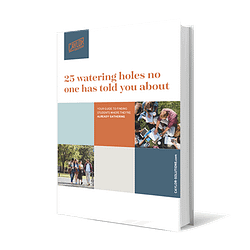
Then it’s time to look beyond the same crowded marketing channels everyone else is using. That’s why we want to share our new ebook: 25 Watering Holes No One Has Told You About. 
With this practical guide, you’ll discover how to:
In short, you’ll gain a fresh roadmap for connecting with the right students—long before they ever fill out an application. Download your free ebook today!
Images via chatgpt.com


Subscribe to The Higher Ed Marketer podcast today!
Servant leadership in higher education starts with curiosity, empathy, alignment, and accountability. Greg Aden shares practical advice.

Build a mission-fit SEM strategy that aligns keywords, ads, and landing pages to attract right-fit students and reduce wasted spend.

Improve higher ed creative operations with practical strategies for protecting creative time, streamlining workflows, and supporting stronger teams.