
Simplifying Higher Ed Marketing: Why Fewer Campaigns Can Produce Better Results
Simplifying higher ed marketing starts with better campaign priorities. Learn what to continue, combine, pause, or eliminate.


Branding
Building trust in higher education is challenging enough for established institutions. But what happens when you’re launching a brand new university with no alumni network, no decades-long reputation, and no established enrollment pipeline?
How do you convince students and families to invest their time, money, and future in something that hasn’t fully proven itself yet?
That’s a pretty tall order!
Higher education is facing significant challenges, from growing concerns about affordability to increased competition for prospective students. While some institutions are struggling to maintain enrollment, others are taking the bold step of building something entirely new.
That’s exactly what’s happening at Orlando Christian University (OCU).
 In this episode of The Higher Ed Marketer Podcast, I sat down with my friend Matt McGee, Provost and Executive Vice President of Orlando Christian University, to discuss what it takes to launch a university from scratch.
Matt and his team are doing something remarkable. They’re building a new Christian university while simultaneously navigating accreditation, developing academic programs, establishing strategic partnerships, and recruiting their first students.
And they’re doing it with a relatively small team and a commitment to keeping education accessible.
What I found especially fascinating about our conversation wasn’t simply the process of starting a university.
It was how much of Matt’s experience applies to the everyday challenges higher ed marketers face.
Whether you’re launching a new academic program, entering a new recruitment market, or trying to rebuild your institution’s reputation, the lessons are surprisingly similar.
It all comes down to understanding your mission, communicating your value, and earning the trust of the students you’re trying to reach.
When I asked Matt how Orlando Christian University plans to earn the trust of prospective students and their families, I was particularly interested in his answer.
After all, an established university has advantages that a new institution simply doesn’t.
It has graduates who can testify to the quality of its education. It has institutional history, recognizable buildings, established academic programs, and community relationships that have developed over generations.
A brand new university doesn’t have those things yet.
So where do you start?
For Matt, the answer begins with excellence.
[Even in these early days,] as we’re preparing the ground and building in faith that the Lord will send the rain, we’re also doing our best to build with excellence.
Whether it’s someone’s first visit to our homepage, a grammatical error in our academic catalog, or outdated information on our website, we’ve tried to pay attention to those details.
God has provided some key partners and people. We have a small but excellent team, many of whom bring higher education experience from other institutions. They’re great leaders, and we’re working diligently to prepare an excellent educational experience for the students who are coming.
I love this perspective because it reinforces something I’ve shared with higher education marketing teams for years.
Think about the experience of a prospective student discovering your university for the first time.
They visit your website. Are the pages professionally designed? Is the information current? Can they easily find the programs they’re interested in?
They download an academic catalog. Does it clearly communicate what they’ll learn and what the experience will cost?
They contact admissions. Does someone respond quickly with helpful information?
These may seem like small details, but together they communicate something much bigger.
They tell students whether your institution is prepared to deliver on its promises.
This is especially important for new institutions, but it’s equally relevant for established universities.
Your higher education brand awareness campaigns can be outstanding, but if the experience doesn’t match the promise, you’ve created friction.
And friction creates uncertainty.
Matt shared an analogy about how people judge a bank’s financial competence partly by how clean its lobby appears.
The condition of the lobby has little to do with managing money, but it shapes the customer’s confidence.
Higher education works much the same way.
A prospective student may not yet understand your curriculum, teaching philosophy, or academic outcomes.
But they’ll notice whether your communications appear professional, intentional, and consistent.
Excellence isn’t just an operational priority. It’s a fundamental part of building trust in higher education.
One of the biggest challenges facing a new university is explaining exactly what makes it different.
But established institutions sometimes struggle with this, too.
Ask ten people across your campus what makes your institution distinctive, and you might get ten very different answers.
That’s a problem.
Strong university branding strategies begin with clarity about who you are, who you serve, and why your institution exists.
For Orlando Christian University, that mission centers on preparing the next generation of Christian leaders.
Matt explained that the university’s vision grew from recognizing a need for accessible, faith-based higher education opportunities in Central Florida.
The institution is being developed through relationships involving First Baptist Orlando, The First Academy, and other important partners.
That mission provides a foundation for every major decision, from academic programming to recruitment.
Matt made this point especially well during our conversation.
For us, it’s about being relentlessly clear about exactly who we are. You’ve probably heard the saying, “Communicate your vision until you’re tired of hearing yourself talk about it, and then communicate it again.”
I live in this world. I think about our programs constantly, and I’ve had hundreds of conversations about them. Yet I’m regularly surprised by how many questions people still have and how much clearer we need to be.
I don’t think you can be too clear, say it too often, or communicate it too well.
What Matt describes is something every higher ed marketer should recognize.
We spend so much time thinking about our institutions that we sometimes forget how unfamiliar prospective students are with them.
We know our academic programs, campus culture, and institutional terminology.
But students and families are encountering our messaging for the first time.
They’re asking basic questions.
What makes this university different? Who is it designed to serve? What will my educational experience look like? Why should I choose this institution over another?
Your messaging needs to answer those questions clearly and repeatedly.
This is where mission-fit student recruitment becomes essential.
For OCU, that includes students interested in Christian leadership, ministry, and service.
And the university’s approach to affordability and accessible education becomes part of that distinctive value proposition.
When your mission and messaging align, your marketing becomes much more compelling.
Students aren’t just purchasing a degree.
They’re investing in an experience they believe will transform their lives.
That’s a powerful brand promise.
One of my favorite parts of this conversation was discussing the importance of strategic partnerships.
Especially for smaller faith-based institutions, partnerships can become one of the most effective student recruitment strategies available.
Too often, smaller universities look at the marketing efforts of large state institutions and assume they need to compete using the same playbook.
But that’s not necessarily true.
In fact, smaller institutions often have advantages that larger universities don’t.
They have access to specific communities, organizations, and relationships where their mission resonates naturally.
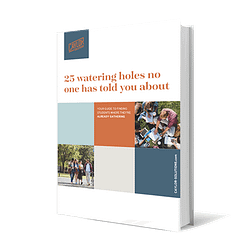
In my book Chasing Mission Fit, I talk about identifying the places where your ideal students already gather.
I call these places “watering holes.”
For Orlando Christian University, local churches and ministry organizations are natural watering holes.
Matt shared that OCU already serves more than 200 associate’s degree students, primarily through concurrent enrollment, but its inaugural bachelor’s program will require expanding beyond that existing student pipeline.
The university’s goal is to welcome 25 students into its inaugural bachelor’s degree in Ministry Leadership in fall 2027.
To achieve that goal, the team is developing relationships with pastors and churches throughout Central Florida.
They’re about building trust through people who already have meaningful relationships with prospective students.
Think about it.
If a respected pastor recommends an educational opportunity to someone in their congregation, that recommendation carries credibility.
But the university must first earn the pastor’s confidence.
Matt emphasized the importance of approaching these relationships intentionally.
Trust is the currency of leadership. If we’re asking pastors to recommend our university or make it available to their congregations, we first have to earn their trust.
I believe trust comes through relationships. Having worked in donor development, I’ve seen a tendency to believe that relationship building can’t be strategic or methodical. But I think you have to have both.
You need a plan, and you need to be genuine. If you’re not strategic about planning events, tracking relationships, and creating opportunities to connect, you’re leaving a lot of low-hanging fruit on the tree.
What I appreciate about Matt’s perspective is his recognition that authentic relationships and strategic planning aren’t mutually exclusive.
You can genuinely care about people while developing an intentional process for building and maintaining relationships.
In practical terms, that might include:
OCU is also exploring how podcasting can help develop relationships with pastors across Central Florida.

I think that’s a great example of using content marketing as a relationship-building tool.
Instead of simply asking an organization to promote your university, create something valuable that opens the door to an ongoing conversation.
These principles aren’t exclusive to faith-based institutions.
A university launching a healthcare program might build relationships with regional hospitals.
An institution developing a new business degree might partner with employers and professional associations.
The best student recruitment strategies start by understanding where your mission-fit students already have relationships and who influences their decisions.
Launching a university requires an enormous amount of planning.
And as Matt explained, you’re often building the plane while flying it!
OCU is developing academic programs, establishing operational processes, and working through accreditation with the Association for Biblical Higher Education (ABHE).
Accreditation requires significant attention, but Matt sees the process as an opportunity for continuous institutional improvement.
It forces the team to evaluate whether its processes, policies, and academic experiences align with the university’s mission.
That discipline is important for enrollment marketing, too.
As marketers, we’re constantly balancing immediate priorities with long-term goals.
We need applications this year.
But we also need to cultivate the students who won’t be ready to enroll for another year or two.
For OCU, success in fall 2027 means more than welcoming 25 bachelor’s degree students.
It also means having a healthy recruitment pipeline for fall 2028 and beyond.
A successful inaugural class is a milestone, but sustainable enrollment growth requires a repeatable strategy.
Are you investing all your resources in students who are ready to enroll immediately?
Or are you also building relationships with students who are just beginning their college search?
Effective enrollment marketing requires both.
It also requires a willingness to adapt.
Matt described the challenges of maintaining a clear institutional vision while remaining flexible about how the university gets there.
OCU is intentionally pursuing a lower-overhead model rather than relying on extensive new facilities.
That creates constraints, but it also encourages creativity.
There’s a valuable lesson here for every higher education marketing team.
You don’t need unlimited resources to build something meaningful.
You need a clear mission, an intentional plan, responsible ownership of your priorities, and the courage to take the next step.
And perhaps most importantly, you need to remember the students behind the enrollment numbers.
Matt shared a story about a receptionist at The First Academy who approached him after hearing about OCU’s planned bachelor’s program.
She was completing her associate’s degree and wanted to become a Christian school teacher.
She told Matt she wanted to be one of those first 25 students.
That moment put a face to the university’s enrollment goals.
It wasn’t simply about reaching a number.
It was about creating an opportunity for someone whose educational ambitions aligned with the institution’s mission.
That’s what mission-fit recruitment is all about.
What I appreciate most about Matt’s story is that he’s not waiting until Orlando Christian University is fully established to start building trust.
He’s doing it now.
Through clear communication, attention to detail, meaningful partnerships, and a commitment to student transformation, the university is creating the foundation for its future.
And there’s an important lesson here for every institution.
You don’t have to be launching an entirely new university to apply these principles.
Whether you’re introducing a new program, repositioning your brand, or entering a new recruitment market, students need to understand why they should trust you.
The strongest university branding strategies aren’t simply about creating attractive marketing materials.
They’re about making a clear promise and consistently delivering on it.
There’s so much more to learn from Matt’s experience launching Orlando Christian University, and I encourage you to listen to the full episode of The Higher Ed Marketer Podcast.
Listen to our interview with Matt McGee to discover even more about:
Build Trust. Attract the Right Students. Grow Enrollment.
At Caylor Solutions, we help colleges and universities build enrollment marketing strategies that connect their distinctive missions with the students they’re best equipped to serve.
From brand positioning and messaging to website strategy, digital marketing, and enrollment campaigns, we help institutions communicate their value, build credibility, and attract mission-fit students.
If you’re launching something new or struggling to communicate what makes your institution different, we’d love to help.
Contact Caylor Solutions to start building a marketing strategy that earns trust and supports sustainable enrollment growth.
Then you’ve got to know how to write for the web. That’s why we want to send you our popular ebook: Writing for the Web: 7 Secrets to Content Marketing Success for Education Marketers!
With this helpful resource, you’ll learn how to:
In short, you’ll be able to write the copy that makes your digital marketing strategy work for you. Download your copy today!
images via orlandochristianuniversity.org



Subscribe to The Higher Ed Marketer podcast today!
Simplifying higher ed marketing starts with better campaign priorities. Learn what to continue, combine, pause, or eliminate.

Discover how intentional leadership in higher education helps leaders break the reaction cycle, reclaim time for strategic thinking, and empower their teams.

Build a college differentiation strategy that turns your institution’s strengths into a clearer enrollment advantage.