
Sustainable Enrollment Growth: How Carthage College Built Record Classes
Discover how Carthage College achieved sustainable enrollment growth through campus-wide teamwork, personalized recruitment, and student-first strategies.


Marketing Strategies
Higher ed marketing team preparation can get squeezed between the final enrollment push and the first demands of the next recruiting season.
Your admissions counselors are following up with prospective students. Your marketing team is managing campaigns, updating the website, responding to requests from academic departments, and keeping the institution’s story moving forward.
Then someone asks for the marketing plan for the next enrollment cycle.
And suddenly, everyone is talking about new campaigns, advertising budgets, content calendars, and recruitment events before taking time to evaluate what happened during the last cycle.
I understand why. When your team is small and enrollment expectations are high, planning can feel like one more responsibility competing with the work already on your desk.
But I’ve come to believe that some of the most valuable marketing decisions happen before anyone begins designing the next campaign.
A little honest assessment, thoughtful prioritization, and alignment around your institutional mission can help your team enter the next enrollment cycle with greater confidence.
And you don’t need a large staff or an elaborate strategic planning process to begin.
A: Colleges should begin higher ed marketing team preparation with an honest assessment of enrollment performance, clear institutional priorities, and alignment around the students they are best equipped to serve.
Ideally, planning begins several months before the next major recruitment push, with a focused review at least 90 days before launch. Marketing, admissions, enrollment leadership, and other relevant campus partners should participate.
Teams should examine enrollment conversion, audience performance, student engagement, marketing effectiveness, and available staff capacity. Those findings should lead to a short list of priorities, clear ownership, and a realistic implementation calendar.
The goal is a coordinated marketing team that understands whom it needs to reach, what those students need to know, and how its work supports the institution’s mission and enrollment goals.
One of the most common planning mistakes in higher education is waiting until the team has finished one enrollment cycle before seriously preparing for the next.
Unfortunately, enrollment cycles rarely provide such a convenient break.
Your team may still be working to enroll the current class while prospective students for the following year are already researching institutions, visiting campuses, and making decisions about their options.
According to the Common App’s 2025–2026 end-of-season report, applicants submitted an average of 7.06 applications, compared with 6.79 during the preceding cycle.
That represents more applications per student among Common App institutions, which creates additional pressure to communicate your college’s distinctive value.
Students are considering multiple options. Your institution needs to be ready when those students begin paying attention.
For most institutions, I recommend beginning the strategic planning conversation three to six months before the next major recruitment push.
The exact timing will depend on your enrollment calendar, student populations, budget approval process, and the amount of change you’re considering.
A major website redesign or CRM implementation may require a longer runway. Smaller adjustments to campaign messaging or recruitment communications may move more quickly.
At a minimum, give your team 90 days to prepare before a significant campaign launch.
That doesn’t mean spending three months in planning meetings. It means giving people enough time to review performance, make decisions, improve important processes, and test what they’re preparing to launch.
Planning early also gives your team something valuable: the ability to make decisions before everything feels urgent.

Before you decide what to do next, you need a reasonably clear understanding of what’s happening now.
I’m not suggesting that every college conduct a comprehensive institutional audit every year.
But you should be able to answer a few foundational questions.
Those questions may reveal opportunities that another marketing campaign wouldn’t solve.
For example, your digital advertising might be generating qualified prospective students, but those students encounter confusing financial aid information when they visit your website.
Or your admissions counselors may be receiving promising inquiries but lack the time or communication resources to follow up consistently.
In either situation, increasing advertising spending may simply send more prospective students into an experience that needs improvement.
If you’re beginning that process, our article on evaluating fall enrollment results through a mission-fit lens provides a helpful starting point.
Remember that an honest assessment should also identify what’s working.
Your team deserves to know which efforts are delivering value so those activities receive the attention and resources they need to continue.
Marketing teams have access to more data than ever.
Website analytics, CRM reports, digital advertising dashboards, email platforms, application systems, and enrollment reports can generate an impressive amount of information.
But more reports don’t necessarily produce better decisions.
For your next enrollment cycle, focus first on the information that helps you understand student behavior and make specific improvements.
Look beyond the total number of inquiries or website visitors.
Which academic programs, geographic markets, student populations, and recruitment channels are producing prospective students who demonstrate meaningful interest in your institution?
Are those students aligned with what your college offers and the experience it promises?
Review conversion rates across the enrollment journey:
Compare those patterns by audience when you have sufficient reliable data.
A decline at one stage may reveal a communication problem, a confusing process, or an unmet student need.
Website traffic and social media engagement can be helpful indicators, but they rarely tell the complete story.
Look at campus visit registrations, qualified inquiries, application activity, and other actions that demonstrate increasing interest.
Connect those outcomes to marketing channels where your tracking allows, while recognizing that students frequently interact with multiple sources before making a decision.
Examine inquiry follow-up, CRM handoffs, communication timing, and the consistency of your messaging.
Ask whether prospective students receive the information they need when they need it.
Your marketing and admissions teams should be able to recognize the same problems in the enrollment journey and work together to address them.
This final question often receives too little attention.
Review the projects your team completed, the work that was delayed, and the resources required to deliver each major initiative.
Which responsibilities are consuming more time than expected? Where are your skills or staffing gaps?
These answers belong in your planning process alongside your enrollment metrics.
You also need to confirm that departments use consistent definitions and reporting periods. If marketing and admissions disagree about what constitutes an inquiry or a qualified lead, their dashboards can produce conflicting conclusions.
For a smaller institution, a concise dashboard with a handful of well-defined measures can be more useful than dozens of reports nobody has time to discuss.

It’s tempting to assign enrollment marketing planning to the marketing director and ask everyone else to provide feedback after the plan is written.
That approach can create problems before the first campaign even launches.
Marketing may develop a strong message that admissions isn’t prepared to support.
Admissions may establish recruitment priorities without considering the marketing resources required to reach those students.
Academic departments may promote programs without understanding the prospective audiences or enrollment goals involved.
For a small or mid-sized college, I would begin with a core planning group that includes:
Bring in financial aid, academic leaders, IT or CRM staff, and student-facing colleagues as their expertise becomes relevant.
You don’t need everyone attending every meeting.
But you do need the right people contributing to the decisions they understand best.
A focused planning session can begin with three questions:
From there, agree on the responsibilities each department will own.
If marketing is responsible for generating inquiries, admissions needs a clear process for engaging those students.
If financial aid information is affecting enrollment decisions, the financial aid team needs to participate in improving those communications.
This kind of coordination is why we’ve emphasized aligning marketing and enrollment teams as an essential part of institutional marketing effectiveness.
Every institution has limited time and resources.
The question is how to invest those resources in ways that support both enrollment goals and the students your institution is uniquely prepared to serve.
That’s where Mission-Fit Marketing becomes particularly valuable.
Your college has distinctive strengths, values, programs, relationships, and educational experiences.
Some prospective students will find those characteristics especially compelling. Others may discover that a different institution better serves their needs.
Good marketing helps students understand that fit before they make a major educational and financial commitment.
As you prepare for the next enrollment cycle, consider:
The answers should influence your audience priorities, content strategy, recruitment channels, and institutional messaging.
For example, a small private college known for close faculty relationships might discover that prospective students respond especially well to opportunities to meet professors and learn about undergraduate research.
That insight could justify investing more in faculty-led content, student stories, and academic department engagement.
The institution would be building its marketing around something it can authentically deliver.
Our Mission-Fit Enrollment Funnel article explores how this approach helps colleges evaluate prospective student quality alongside inquiry volume.
Mission alignment provides a useful filter when different departments compete for marketing attention.
It gives leaders a shared basis for determining which opportunities deserve the most resources.
Here’s a planning question I wish more institutional leaders would ask:
Can the people responsible for this plan realistically execute it?
In this 2026 report on higher education marketing capacity, 65% of the 121 marketing leaders surveyed were facing higher goals with flat or shrinking staff and budgets.
That finding will sound familiar to many small college marketing directors.
Your team may include a marketing director, a graphic designer, someone managing digital communications, and a few colleagues who contribute part-time to recruitment projects.
Those same people may also support advancement, alumni relations, presidential communications, athletics, and academic departments.
Planning without considering that workload can leave your institution with an impressive strategy that nobody has the capacity to implement.
Before approving the next marketing calendar, look at three areas.
Does your team have the experience required for its highest-priority work?
You may need stronger capabilities in analytics, CRM management, digital advertising, content strategy, or emerging technologies.
Not every gap requires a new employee. Some can be addressed through training, process improvements, or targeted consulting support.
Every significant initiative needs someone responsible for completing it.
That doesn’t mean one person must do all the work.
It means there should be no confusion about who coordinates the campaign, manages the deadlines, and reports on progress.
If every hour is committed to producing new marketing materials, your team has little opportunity to evaluate results and improve what it’s already doing.
Reserve time for reviewing performance, testing messages, and responding to what students are telling you.
A reasonable plan gives your team room to learn, not simply produce.
The next enrollment cycle will bring its own challenges.
Some recruitment efforts will outperform expectations. Others will need adjustment.
Students will ask questions you didn’t anticipate. Academic departments will identify new opportunities. Your leadership team may need to reconsider priorities as enrollment patterns develop.
You cannot prepare for every possibility.
But you can prepare your marketing team to respond thoughtfully.
Begin with an honest understanding of what’s working and what needs attention.
Bring the right people into the conversation.
Choose priorities that support your institution’s mission and the students you’re best positioned to serve.
Then give your team a realistic plan, clear responsibilities, and the resources it needs to execute.
When that foundation is in place, your next enrollment cycle becomes an opportunity to build on what you’ve learned.
Ready to Build a Stronger Enrollment Marketing Plan?
Sometimes the most difficult part of preparing for the next enrollment cycle is finding the time and perspective to evaluate what’s happening while you’re still managing the demands of the current one.
An experienced outside partner can help your team identify what deserves attention, bring stakeholders into alignment, and turn broad institutional goals into a practical marketing plan.
Through Caylor Solutions’ Consulting Services and Marketing Audit & Recommendations, we help colleges and universities assess their current efforts, clarify marketing priorities, identify opportunities for improvement, and develop strategies grounded in their mission and enrollment goals.
Whether your team needs an objective assessment, support with strategic planning, or guidance translating its priorities into action, we’re here to help.
Let’s talk about preparing your marketing team for the next enrollment cycle.
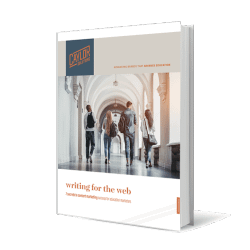
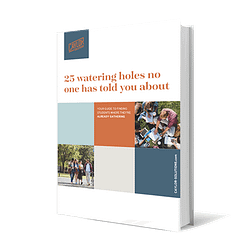
Then it’s time to look beyond the same crowded marketing channels everyone else is using. That’s why we want to share our new ebook: 25 Watering Holes No One Has Told You About.
With this practical guide, you’ll discover how to:
In short, you’ll gain a fresh roadmap for connecting with the right students—long before they ever fill out an application. Download your free ebook today!
images via chatgpt.com



Subscribe to The Higher Ed Marketer podcast today!
Discover how Carthage College achieved sustainable enrollment growth through campus-wide teamwork, personalized recruitment, and student-first strategies.

AI marketing leadership in higher ed requires strategy, judgment, and cross-campus alignment. Here’s a practical plan for CMOs and VPs.

Building trust in higher education starts with a clear mission. Discover how new universities can attract students, earn credibility, and grow enrollment.