Event Branding in Higher Education
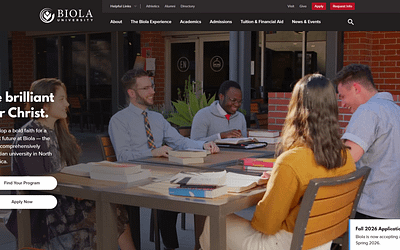
Want to optimize your campus events? Learn how Biola University turns every touchpoint into a living brand story through strategic event branding in higher education.


Marketing Strategies
Higher ed YouTube marketing can help colleges build trust with prospective students long before they ever step on campus.
For many enrollment and marketing teams, YouTube has become a storage closet.
It holds old livestreams, a few polished brand videos, maybe a campus tour, and a collection of videos no one has organized in years.
That is a missed opportunity.
Today’s prospective students are using YouTube to learn, compare, explore, and decide what feels trustworthy.
Parents are there too, often looking for the deeper reassurance that a short social post or admissions brochure cannot provide.
When your team is stretched thin and under pressure to produce results, it is tempting to think of video as one more content demand.
Used well, it gives prospective students the chance to hear faculty voices, see real student experiences, understand your mission, and picture themselves in your community before they ever schedule a visit.
In this guide, we’ll look at how colleges can use YouTube as a long-form trust engine for enrollment marketing, not just as a place to park video files.
A: Colleges can use YouTube for enrollment marketing by creating videos that answer the questions students and families ask before a campus visit.
Strong higher ed YouTube marketing includes student stories, faculty conversations, program explainers, campus life videos, financial aid guidance, parent-focused content, and virtual visit support.
The goal is not to post more videos.
The goal is to build trust before the visit by helping students hear real voices, see real community, and understand whether the college feels like a mission-fit choice.
YouTube works best when it is organized around the student journey, connected to website calls to action, and measured by engagement, inquiries, visit registrations, and applications.
YouTube is not a side channel for today’s students.
It is one of the primary places they spend time, ask questions, learn from peers, and explore possibilities.
Pew Research Center found that 90% of U.S. teens use YouTube, and 73% visit the platform daily, making it the most widely used platform in Pew’s 2024 teen survey.
That should get the attention of every higher ed marketer.
If prospective students are already on YouTube, your institution has an opportunity to show up there with substance, rather than just a thirty-second campus montage with drone footage and smiling students on the quad.
Students are asking bigger questions.
That aligns closely with the mission-fit marketing mindset we use at Caylor Solutions.
A mission-fit student is drawn to your story, your community, and your outcomes, not just your list of programs.
YouTube can help those students encounter your story in a human, searchable, and repeatable way.
Most colleges already have a YouTube channel.
The problem is that many of those channels are organized around the institution, not the student.
A repository says, “Here are the videos we have.”
A trust engine says, “Here are the questions we can help you answer.”
That distinction matters.
A student does not care that your livestream archive is complete.
They care whether they can find a real student talking about life in the residence halls.
They care whether a professor can explain what makes your nursing program different.
A parent does not want to hunt through a random playlist called “Campus Events 2022.”
They want reassurance.
They want to know if their child will be safe, supported, challenged, and prepared.
That is where higher ed YouTube marketing becomes more than video management.
It becomes a strategic expression of trust.

A trust-building YouTube channel is organized around the student journey.
It helps students move from curiosity to confidence.
It connects emotion with information.
It gives students something they can watch on their own, share with a parent, or revisit after an admissions conversation.
A practical channel structure might include playlists like these:
The names should feel simple and familiar.
Students should not need to understand your internal departments to find what they need.
This is the same principle that applies to your website.
Your digital presence should guide mission-fit students toward the next right step, not force them to decode your org chart.
The best YouTube strategy starts with the questions students are already asking.
That means your team should stop thinking first about what you want to announce.
Start with what your students need to understand.
Belonging is hard to fake.
Students know when a video feels scripted.
They can sense when the campus community has been overly polished.
That is why student-led content matters.
A dorm tour filmed by a student may not look like a professional commercial, but it may answer more real questions than a glossy brand video.
A day-in-the-life video can show pace, personality, relationships, and little campus details that never make it into a brochure.
As we explored in our Gen Z blog, student-led stories often go farther than paid campaigns because they feel personal, believable, and connected to real experience.
Consider videos like:
These videos should not sound like admissions scripts.
Give students prompts, not paragraphs to memorize.
Let them speak like themselves.
Students are not only evaluating campus life, they are also trying to determine whether your institution can help them become the person they hope to be.
This is where faculty voices matter.
A professor explaining a program in plain language can build trust quickly.
A faculty member who talks about mentoring, classroom culture, research opportunities, internships, or faith integration can make the academic experience feel tangible.
That matters because academic pages on college websites can sometimes feel dry.
Consider videos like:
For small colleges, this can be a significant advantage.
Large universities may have name recognition, but smaller institutions often have closer faculty relationships and clearer stories of transformation.
YouTube gives you room to show that.
Parents and guardians often have different questions than students.
Students may be looking for belonging.
Parents may be looking for safety, support, affordability, and outcomes.
That does not mean your parent content needs to be stiff.
It does need to be clear.
Think about videos like:
YouTube is especially helpful here because it can serve both the student and the family.
YouTube CEO Neal Mohan wrote in 2025 that TV had surpassed mobile as the primary device for YouTube viewing in the U.S. by watch time, and that YouTube had been number one in U.S. streaming watch time for two years, according to Nielsen.
That shift matters.
Some of your prospective students are watching alone on a phone.
Others may be watching with a parent from the couch.
Your content strategy should serve both settings.
There is a common assumption that Gen Z will not watch long-form content.
That is only partly true.
They will not sit through long content that wastes their time.
But they will watch longer videos when the topic matters to them.
Think with Google has reported that Gen Z watches in-depth YouTube content tied to topics they care about, including video essays and longer explorations of personal interests.
For colleges, that is encouraging.
A 12-minute student panel can work.
A 15-minute faculty conversation can work.
A 20-minute virtual visit can work.
The content has to be useful.
Length is not the enemy.
Low relevance is.
Here is a simple way to think about video length:
Short-form video can create discovery.
Long-form video can build confidence.
A healthy YouTube strategy uses both.

YouTube should never sit apart from your enrollment strategy.
Every video should help the viewer take a next step.
This does not mean every video needs to end with a hard sell.
It does mean each video should have a clear path forward.
A student watching a video about your biology program should be invited to visit the biology program page.
A parent watching a financial aid explainer should be linked to the net price calculator, financial aid page, and admissions contact form.
A student watching a day-in-the-life video should be invited to schedule a campus visit.
Caylor’s lead generation website guidance emphasizes that websites should do more than inform.
They should attract, qualify, and convert mission-fit students.
YouTube should support that same goal.
Each video should include:
“Explore the Biology Program.”
“Schedule a Visit.”
“Request Financial Aid Information.”
“Meet Your Admissions Counselor.”
“Watch the Full Campus Tour.”
Students should never have to wonder what to do next.
Views are easy to report.
They are not always the best measure of trust.
A video with 400 views from the right students may matter more than a general brand video with 20,000 passive views.
The better question is whether the video helped a student move forward.
Start by watching these metrics:
Ask admissions counselors what students mention in conversations.
Ask campus visit staff whether students reference specific videos.
Ask student ambassadors which videos feel most accurate to their experience.
Data tells part of the story.
Human feedback fills in the gaps.

A strong YouTube strategy does not require a huge production team.
It requires focus.
Most small college marketing teams are already carrying too much.
You do not need to launch a media company.
You need a repeatable rhythm.
Here is a practical one-semester plan.
Review your existing YouTube channel.
Remove or unlist outdated videos that create confusion.
Rename playlists around student questions.
Update descriptions with current links.
Add CTAs to your best-performing videos.
Identify the ten videos that still build trust.
Record five student videos.
Focus on belonging, transition, academics, community, and why they chose your institution.
Keep the setup simple.
Good audio, natural light, and clear prompts can go a long way.
Choose three priority programs.
Ask one faculty member from each program to explain what students learn, what makes the program distinctive, and what outcomes students can pursue.
Keep the tone conversational.
Record two financial aid videos.
Record one parent-focused visit video.
Record one student support video.
Make these clear, calm, and practical.
Create or refresh your “Before You Visit” video.
Add a “What to Expect on Your Campus Visit” video.
Send these in visit confirmation emails.
Embed them on the visit page.
Look at watch time, traffic, inquiries, visit registrations, and counselor feedback.
Keep what works.
Improve what feels unclear.
Retire what no longer serves the student journey.
This is how higher ed YouTube marketing becomes sustainable.
You build trust one useful video at a time.
Here are practical ideas your team can use right away.
The best ideas usually come from real admissions conversations.
Listen for the questions your counselors answer every week.
Then turn those answers into videos.
A campus visit is still one of the most powerful moments in the enrollment journey.
But the visit does not begin when the student parks the car.
It begins when they first imagine what life on your campus might feel like.
YouTube can help shape that imagination.
It can reduce uncertainty.
It can make faculty feel approachable.
It can help parents feel prepared.
It can give students language for what they are hoping to find.
It can help mission-fit students recognize your institution before they arrive.
That is the real opportunity.
Higher ed YouTube marketing is not about chasing views.
It is about earning trust.
Need Help Building a YouTube Strategy That Supports Enrollment?
If your YouTube channel feels more like a storage closet than a student journey, Caylor Solutions can help.
Our Content Strategy and Marketing services focus on creating and distributing valuable, relevant, and consistent content for a clearly defined audience.
For colleges and universities, that means helping your team identify the right stories, organize your content around the student journey, and connect every video back to enrollment action.
We can help you turn scattered video assets into a strategic content ecosystem that builds trust with mission-fit students and their families.
Because trust is built before the visit.
And when your videos help students feel seen, informed, and invited, your campus visit starts long before they arrive.
It might be time to redesign your enrollment website to get the results you’re looking for.
Download our free Guide to Website Redesign Planning to learn more about how to fix the most common problems school websites have.
 In this guide, you’ll explore how to…
Don’t revamp your website before you check out our free Guide to Website Redesign Planning!
And if you want to go deeper to see how much more you can get out of your enrollment website, contact us for a consultation and a digital marketing audit.
images via chatgpt


Subscribe to The Higher Ed Marketer podcast today!
Want to optimize your campus events? Learn how Biola University turns every touchpoint into a living brand story through strategic event branding in higher education.

Enrollment yield improvement starts with reducing friction, accelerating financial clarity, and converting more high-probability students already in your funnel.
A higher ed website redesign strategy isn’t about technology, it’s about people. Learn how trust-first leadership and change management drive successful campus website redesigns.