
Enrollment Leadership Development: Preparing the Next Generation
Discover why enrollment leadership development is essential to building stronger teams, retaining top talent, and preparing future higher ed leaders.


Branding
An enrollment-focused content strategy gives your college’s marketing efforts a clearer purpose: helping prospective students find the information they need to decide whether your institution is right for them.
That may sound straightforward, but think about how content calendars typically take shape.
An academic department has a new faculty member to announce. The advancement office wants to highlight a generous donation. Someone in the president’s office requests a story about a recent institutional achievement. Meanwhile, your social media manager needs something to post by Thursday.
Before long, your marketing team has produced a steady stream of content, and everyone on campus seems reasonably satisfied.
But the enrollment team is still asking where the next group of prospective students will come from.
There’s nothing wrong with telling institutional stories. Those stories build credibility, strengthen your reputation, and help people understand what makes your college special.
Content marketing and enrollment marketing serve different functions, but they should reinforce one another.
Content marketing attracts and engages audiences through useful information and compelling stories.
Enrollment marketing connects with prospective students and helps them move toward applying, enrolling, and arriving on campus.
An intentional content strategy brings those efforts together.
For smaller private colleges with limited marketing resources, that connection is especially valuable. Every article, video, email, and program page represents an investment of time and attention.
Let’s look at how to make those investments count.
An enrollment-focused content strategy connects useful content to the questions and decisions prospective students face throughout their college search.
It helps students discover an institution, understand its academic offerings, evaluate whether it fits their goals and values, and confidently take the next step.
Effective content answers questions about academic programs, affordability, student experience, career preparation, and admissions requirements. It also demonstrates what makes an institution distinctive so mission-fit students can recognize an environment where they are likely to thrive.
To support enrollment goals, colleges should connect content to specific audiences, stages of the enrollment journey, and meaningful actions.
Success can then be evaluated through engagement, inquiries, campus visits, applications, deposits, and other appropriate enrollment indicators.
One of the biggest mistakes colleges make with content marketing is organizing it around what the institution wants to communicate rather than what prospective students need to understand.
Those priorities often overlap, but they aren’t automatically the same.
Your college may want to announce a new nursing simulation laboratory. That’s good news. It demonstrates investment in the program and can be meaningful to donors, faculty, and prospective students.
But a prospective nursing student may be asking a more personal question:
Will this program prepare me to become a confident, capable nurse?
That question should shape how you tell the story.
Instead of simply announcing the new facility, show students practicing in simulated clinical situations. Explain how the experience connects to their curriculum and clinical preparation. Let a faculty member describe the skills students develop there.
Now the story gives a prospective student something useful for evaluating the program.
The same principle works across nearly every part of your college.
A story about a new scholarship should help students understand affordability. A faculty profile should reveal something meaningful about the classroom experience. A student organization feature should help prospective students imagine finding community on campus.
The subject may stay the same. The way you frame it changes.
Your admissions counselors are sitting on one of the most valuable sources of content strategy information available.
They hear questions that don’t always appear in your marketing meetings.
Questions such as:
These questions reveal the information students need to move forward.
Try asking your admissions counselors to document the ten questions they hear most frequently. Then compare that list with your website and content calendar.
You may discover that some of your most valuable content hasn’t been written yet.
Students don’t all enter the enrollment process at the same place.
Some are just discovering that your institution exists. Others have narrowed their choices to three colleges. Still others have already been admitted and are trying to decide where to deposit.
Each student needs something different.
A useful framework is to organize your content around four stages of the college decision process.
At this stage, students may be exploring careers, academic interests, or types of institutions without considering your particular college.
They’re searching with questions like:
Content at this stage should be educational, accessible, and genuinely useful.
A career exploration article, for example, might help a high school student understand several paths available through an accounting degree.
Your institution’s academic program becomes a natural part of that conversation.
A reasonable next step might be exploring your accounting program page, rather than completing an application before the student is ready.
Once a prospective student has identified your institution as a possibility, the questions become more specific.
This is where mission-fit storytelling becomes especially important.
A general statement about personalized education may be accurate, but students have probably heard similar language from several institutions.
A short video showing a faculty member mentoring students through a challenging project gives that claim substance.
A current student’s story about finding community after transferring from a larger university may help another student picture a similar experience.
Strong consideration-stage content includes program comparisons, faculty interviews, student testimonials, sample classroom experiences, and authentic campus-life videos.
Your next step might invite a student to attend a virtual information session or schedule a campus visit.
Interested students sometimes hesitate because they don’t understand what comes next.
They may be confused about application requirements, financial aid, deadlines, or academic prerequisites.
Good content makes those processes easier.
Think about a clear admissions checklist, an application walkthrough video, or a financial aid explainer written in plain language.
Students shouldn’t need to decode institutional terminology to complete an application.
A 2024 ACT Student Voice study found that 39% of surveyed 11th- and 12th-grade students reported difficulty finding the information they wanted while researching postsecondary options.
That suggests a significant opportunity for colleges willing to make their information easier to find and understand.
Content marketing doesn’t stop when the application is submitted.
An admitted student may still be considering several institutions. They may also be discussing financial concerns, campus culture, or career opportunities with their family.
The right content can help them make a more informed decision.
Consider an admitted-student email series featuring student ambassadors, a video about the first-year experience, explanations of academic advising, or an invitation to speak with a professor.
Families may benefit from straightforward information about financial aid, student support, safety, and career preparation.
The goal is to help students understand what accepting the offer will mean for their lives.
When that picture aligns with what they value, choosing your institution becomes easier.
One helpful way to think about content strategy is to treat each piece of content as part of a larger conversation with the student.
Imagine a prospective student interested in physical therapy.
She discovers a blog post about career paths in exercise science. That article points her to your exercise science program page.
On that page, she watches a student explain how an undergraduate research experience helped prepare him for graduate study.
She signs up for a program information session, where she meets a faculty member and learns about the admissions process.
Later, an email introduces her to another student who shares similar career interests.
Each piece of content serves a distinct purpose, but together they create a coherent experience.
Compare that with a disconnected approach.
The blog post is published but never linked to the program page. The student video lives only on Instagram. The information session is promoted in an email sent to a broad audience. Admissions counselors don’t know what content interested students have already seen.
The institution has produced useful materials, but students must connect the pieces themselves.
That’s an unnecessary burden—and one that can easily be avoided with a bit of structured planning.
You can begin with a simple worksheet. For one priority academic program, identify five things:
Consider a college trying to increase enrollment in its education program.
Its audience might be high school students interested in teaching. One common question could be whether the degree includes meaningful classroom experience.
An article or video featuring students working in local schools could answer that question.
The content could lead to a program-specific campus visit.
Your team could then measure how many visitors viewed the content, clicked through to the program page, and registered for a visit.
This approach gives each content investment a clearer purpose.
There’s no single content format guaranteed to produce enrollment growth.
A beautifully produced video may attract thousands of views without generating meaningful interest in a program. A straightforward financial aid guide may attract a smaller audience but help prospective students overcome a significant concern.
The value depends on the decision the content supports.
I encourage colleges to think about three broad categories of useful enrollment content.
This includes academic program explanations, career guides, financial aid resources, admissions FAQs, and articles comparing educational options.
Its strength is practical usefulness.
Students are searching for answers, and your institution has an opportunity to provide them.
Colleges make many promises about personalized attention, community, academic excellence, and career preparation.
The strongest content provides evidence.
Show the student working with a professor. Describe the internship partnership. Share verified graduate outcomes. Let alumni explain how their education prepared them for their next opportunity.
These stories help students evaluate whether your promises are credible.
For a deeper look at how institutional identity can guide enrollment messaging, read our article on Mission-Fit Marketing as a long-term strategy.

Sometimes the most valuable content is remarkably simple.
A campus visit scheduling page. A clear list of application deadlines. A short guide explaining how to compare financial aid offers.
These resources may never win a creative award, but they serve an important enrollment function.
When you have a limited budget, content that helps a student complete an important action deserves serious attention.
Higher education marketing teams often report content performance through metrics that are easy to access.
Website traffic. Video views. Social media engagement. Email click rates.
Those measures can tell you something, but they rarely tell the whole story.
Imagine your institution publishes two articles.
The first generates 8,000 visits from people researching an educational topic broadly.
The second attracts 350 visitors who are seriously considering your college’s engineering program.
Several visitors from the second article register for a program information session.
Which article performed better?
It depends on the article’s objective, but the second may be making a more direct contribution to the enrollment pipeline.
This is why I recommend measuring content at three levels.
Are prospective students finding your content?
Look at organic search traffic, search impressions, relevant keyword visibility, referrals, and reach among priority audiences.
These measures tell you whether your institution is entering the conversation.
Are students using the content to learn more and take appropriate steps?
Track visits to related program pages, engaged sessions, meaningful CTA clicks, campus visit registrations, information requests, and application starts.
These signals help you understand whether your content is supporting deeper consideration.
Are students who interact with your content progressing through the recruitment process?
Where systems allow, connect website analytics with CRM and enrollment data to examine inquiry-to-application conversion, visit-to-application conversion, deposit behavior, and yield.
Be careful about attribution.
A student who reads three articles before enrolling didn’t necessarily enroll because of those articles. Other experiences, including counselor conversations, family advice, campus visits, and financial aid offers, may have influenced the decision.
Still, content engagement can help reveal useful patterns, particularly when you compare groups carefully and track performance over time.
For smaller colleges, this doesn’t require an elaborate reporting system on day one.
Start with a few meaningful conversion events and clear naming conventions. Add complexity as your team learns what information is useful.
For additional perspective on evaluating lead quality rather than raw inquiry volume, see our article on the Mission-Fit Enrollment Funnel.

An enrollment-focused content strategy can’t operate effectively if marketing and admissions rarely compare notes.
Your marketers may understand search behavior and digital engagement. Your admissions counselors understand the questions students ask, the concerns families raise, and the moments when prospective students hesitate.
Both perspectives matter.
A short monthly meeting can be of significant value.
Ask the admissions team which questions are becoming more common, which programs are getting increased interest, and where students seem confused.
Then ask marketing which existing content is attracting relevant visitors, where students are dropping off, and which content pathways are producing useful actions.
Together, decide what to improve.
Maybe your financial aid explanations need work. Perhaps an academic program page needs stronger student outcomes information. Or a frequently asked question could become a short video that counselors can share directly.
This collaboration makes your content more responsive to the actual enrollment process.
It also helps prevent the familiar problem of marketing producing materials that the admissions team never uses.
You don’t need to rebuild your entire marketing operation to make progress.
For a smaller institution, I would start with one priority enrollment audience or academic program.
Week 1: Listen to student questions.
Ask admissions counselors for common questions, review your website search data, and identify where prospective students encounter uncertainty.
Week 2: Evaluate existing content.
Review the content those students are likely to encounter. Look for outdated information, missing answers, vague messaging, and pages with no clear next step.
Week 3: Improve three high-value resources.
You might rewrite a program page, add a financial aid FAQ, and connect an existing student story to a campus visit registration page.
Week 4: Measure and learn.
Put basic tracking in place and establish a regular review schedule.
Your goal for the first month is to improve a few important student decision points, create clearer pathways, and establish a way to learn from results.
You can expand the approach once your team understands what works.
A content audit also helps you make better use of what you’ve already created. Often, the best next move is to update, connect, or redistribute an existing asset rather than commission another piece of content.
Awareness has value. So do institutional reputation, community engagement, and storytelling that builds pride among alumni and faculty.
But when enrollment growth is a priority, your content strategy should also help prospective students move from curiosity to confidence.
That requires understanding their questions, communicating your institution’s distinctive strengths, removing unnecessary barriers, and making the next step clear.
The colleges that do this well will build something more useful than a busy content calendar.
They’ll create a collection of resources that supports prospective students throughout the college decision process. Over time, that collection becomes a valuable institutional asset.
And perhaps most importantly, it helps mission-fit students recognize the place where they can belong, grow, and succeed.
Build an Enrollment-Focused Content Strategy With Caylor Solutions
If your marketing team is producing plenty of content but struggling to connect that activity with enrollment goals, it may be time to rethink the strategy behind the work.
At Caylor Solutions, our Content Strategy and Marketing services help colleges and universities develop audience-focused content that answers real student questions, communicates institutional strengths, and guides prospective students toward meaningful next steps.
We can help you evaluate your current content, identify gaps in the enrollment journey, and build a more intentional approach to creating and distributing useful materials.
Let’s talk about creating an enrollment-focused content strategy that makes better use of your marketing resources.
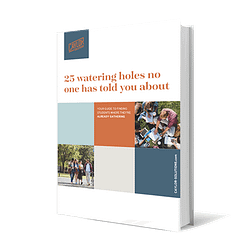
Then it’s time to look beyond the same crowded marketing channels everyone else is using. That’s why we want to share our new ebook: 25 Watering Holes No One Has Told You About. 
With this practical guide, you’ll discover how to:
In short, you’ll gain a fresh roadmap for connecting with the right students—long before they ever fill out an application. Download your free ebook today!
images via chatgpt.com



Subscribe to The Higher Ed Marketer podcast today!
Discover why enrollment leadership development is essential to building stronger teams, retaining top talent, and preparing future higher ed leaders.

See where AI admissions support can save time, strengthen communication, and help teams without replacing human judgment.
Discover a practical higher ed change management framework for knowing when to push, pull, or pause while leading through institutional change.