Higher Ed Change Management: When to Push, Pull, or Pause
Discover a practical higher ed change management framework for knowing when to push, pull, or pause while leading through institutional change.


Enrollment
AI admissions support is most valuable when it gives your team more time to do the work that requires a human being.
Admissions teams are carrying a tremendous amount of operational work.
There are emails to write, visits to schedule, inquiries to follow up with, application data to review, reports to prepare, event questions to answer, and prospective students at very different stages of their decision.
For smaller institutions, those responsibilities often fall on teams that were stretched long before generative AI arrived.
So I understand the appeal of a tool that promises to do more with less.
I also think we need to be careful about what we mean by “more.”
The goal shouldn’t be to automate the relationship between your institution and a prospective student.
The goal should be to reduce the work surrounding that relationship so your admissions professionals have greater capacity to listen, respond, advise, and help students decide whether your institution is truly a good fit.
That gives us a fairly simple test for AI: Use it to support the work around human discernment, not to replace human discernment itself.
A: AI admissions support can help colleges automate repetitive administrative work, draft and personalize routine communications, organize information, analyze enrollment data, prepare staff for conversations, and make common information easier for students to access. It should not independently make high-stakes admissions judgments, interpret a student’s motivations or circumstances without human review, or replace the personal conversations that build trust and help students determine institutional fit.
A good implementation starts with low-risk, repetitive work. Keep admissions professionals responsible for judgment, exceptions, sensitive conversations, relationship building, and important student decisions. Protect student data, establish clear AI-use policies, review AI-generated output, and measure whether the technology creates more capacity for meaningful student interaction rather than simply increasing communication volume.
There is a temptation with every new technology to begin with the tool.
I’d start with the work.
Ask your admissions team what consumes time without requiring much judgment.
Those tasks might include:
That is where I would look first.
Those are useful clues for admissions leaders.

The best first use of AI may not be some ambitious “AI enrollment strategy.” It may be giving an admissions counselor 30 minutes back every afternoon because she no longer has to turn five pages of notes into five follow-up messages from scratch.
Multiply that across a semester and you have created meaningful capacity.
Communication is one of the clearest opportunities for AI, but it is also where teams can get into trouble.
Prospective students already receive a lot of enrollment communication. Giving a college the ability to produce even more of it is not necessarily an improvement.
The better opportunity is relevance.
AI can help a team take one piece of information and adapt it for an admitted student, a parent, an international prospect, or a student who has registered for a campus visit.
It can help an admissions counselor take rough notes after a phone call and create a thoughtful first draft for follow-up.
It can help surface which questions keep appearing in inquiry conversations so the institution can improve its website, email sequences, financial aid explanations, or admitted-student resources.
Your communication becomes more useful because it helps the right student understand your institution more clearly.
That is quite different from using AI to generate thousands of increasingly personalized messages designed simply to increase application volume.
Your admissions technology should help students answer an important question: Could I belong and thrive here?
A human being still has an important role in helping them answer it.
Admissions offices sit on valuable information.
The problem for a small enrollment team is often not a lack of data. It’s having enough time to make sense of it.
A team might analyze several hundred open-ended responses from admitted students and identify recurring themes. It might compare inquiry questions across recruitment territories. It might help staff explore where students are encountering friction in the admissions process.
The output should be treated as analysis to investigate, not the final truth of the matter.
I’m very optimistic of AI’s use in admissions, but there are serious concerns about misinformation, data used without consent, insufficient data protection, and the loss of skills requiring independent thought that leaders should be concerned about.
While AI can surface a pattern in the data, your team still needs to ask whether that pattern makes sense, whether the underlying data is reliable, and what action is appropriate.
Some admissions work contains too much context, consequence, or emotion to hand over to automation.
I would keep people clearly in charge of areas such as:
AI can organize information, but it should not become the final arbiter of an applicant’s potential, character, circumstances, or institutional fit.
Human beings understand context that a model may miss.
They can recognize an unusual life situation, ask another question, challenge an assumption, or understand why something in an application doesn’t tell the whole story.
A student worried about paying for college does not always need a better answer from a chatbot.
Sometimes that student needs someone who hears the fear underneath the question.
The same applies to conversations about family expectations, belonging, academic preparedness, disability, a disappointing financial aid package, or uncertainty about whether college is the right next step.
Every year, prospective students are concerned about affordability, belonging, preparedness, and the complexity of the admissions process.
Students described meaningful admissions experiences as ones that reduced uncertainty and helped them feel that someone was genuinely invested in them.
Those are deeply human outcomes that are sensitive and sometimes complex.
Use technology to make room for those conversations, not eliminate them.
Your institution knows things about itself that cannot be reduced neatly to fields inside a CRM.
Admissions professionals understand the culture of your campus. They know which students tend to flourish there. They hear what families are nervous about. They recognize the difference between a student asking for information and a student asking for reassurance.
AI can help organize what your team knows. It cannot take responsibility for caring whether a particular student finds the place where he or she can thrive.

You do not need a fifty-page AI strategy before experimenting.
Don’t begin with application decisions.
Start with something such as email drafting, meeting summaries, FAQ development, call preparation, or analysis of non-sensitive survey data.
Make the problem specific enough that you can tell whether AI helped.
If students will receive the output, someone should be responsible for it.
Review factual claims. Check tone. Watch for fabricated details. Make sure the communication actually sounds like your institution.
“AI wrote it” will never be an acceptable explanation to a student who received incorrect information.
Be very cautious about putting personally identifiable applicant or student data into consumer AI products.
Your admissions team should know which tools are institutionally approved, what information may be entered into them, how data is handled, and when an AI tool should not be used at all.
Most institutions do not need one person experimenting while everyone else watches.
Create shared practices.
Compare prompts. Discuss failures. Show examples of hallucinations. Identify tasks where AI worked well and others where it created more work. Teach people what information is safe to use.
This may be the metric leaders should care about the most.
Don’t simply ask, “How many emails did AI help us create?”
Ask:
If AI produces twice as much activity but makes your student experience less personal, you may not have gained anything.
I don’t think the central question is whether admissions offices will use AI.
Many already are.
The more useful question is what kind of admissions office you want AI to help you become.
If artificial intelligence gives your counselors more time to call a nervous student, prepare thoughtfully for a family meeting, notice an enrollment pattern, clarify a confusing message, or help a prospective student see why your institution fits, then the technology is doing valuable work.
If it simply lets you automate more of the student relationship, I would reconsider the strategy.
We should be trying to remove friction from admissions without removing humanity from admissions.
That is a much better standard for deciding where AI belongs.
Build an AI Practice Your Admissions Team Can Actually Use
Knowing that your team “should use AI” is easy.
Determining which workflows to change, which tools to trust, what data is appropriate to use, and how to help your staff become confident using AI takes more work.
Caylor Solutions offers Custom AI Masterclasses and Custom Team Training designed around the actual work your institution needs to accomplish.
Rather than handing your team another generic presentation about artificial intelligence, we can help you identify useful applications, establish practical guardrails, and develop workflows that support enrollment and marketing without losing the human character of your institution.
If your admissions or enrollment team is trying to figure out where AI genuinely helps, let’s start there.
Contact us today.
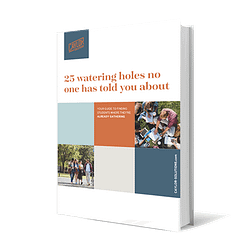
Then it’s time to look beyond the same crowded marketing channels everyone else is using. That’s why we want to share our new ebook: 25 Watering Holes No One Has Told You About. 
With this practical guide, you’ll discover how to:
In short, you’ll gain a fresh roadmap for connecting with the right students—long before they ever fill out an application. Download your free ebook today!
images via chatgpt.com



Subscribe to The Higher Ed Marketer podcast today!
Discover a practical higher ed change management framework for knowing when to push, pull, or pause while leading through institutional change.

Learn why higher ed marketing clarity matters more than reach—and how private colleges can reduce confusion, build trust, and attract mission-fit students.

Discover how mission-fit student recruitment can help colleges move beyond shrinking name buys, find the right students, and build stronger enrollment pipelines through long-term, trust-based relationships.