Your college may be more visible than ever, but if your school can’t create higher ed marketing clarity, you can still be lost in the crowd.
You are running digital campaigns. Your social channels are active. Your logo appears on billboards, banners, emails, search results, and high school posters. Website traffic is up. Impressions look healthy.
But applications are flat.
That is usually when someone says, “We need more awareness.”
Maybe. But awareness may not be the real problem.
A prospective student can recognize your name and still have no idea why your institution belongs on their list. A parent can visit your website and leave without understanding the actual cost. A student can watch three videos and still be unable to explain what makes your college meaningfully different.
That is the difference between visibility and clarity.
Visibility attracts attention. Clarity attracts the right students.
For small and mid-sized private colleges, this distinction matters. You probably cannot outspend the largest institutions in your market. But you can communicate your mission, value, outcomes, and student experience with greater focus.
That is the opportunity behind higher ed marketing clarity.
Q: What is the difference between visibility and clarity in marketing?
A: Visibility determines whether people encounter your institution. Clarity determines whether they understand who you are, why you are different, whether you fit their goals, and what they should do next. Visibility earns attention; clarity turns that attention into confidence and action among mission-fit students.
Visibility and Clarity Do Different Jobs
Visibility answers:
- Have students heard of us?
- Are we appearing in the places they search?
- Are our campaigns reaching enough people?
- Are people visiting our website?
Clarity answers:
- Do students understand whom we serve?
- Can they explain what makes us different?
- Can they see evidence supporting our claims?
- Can they find the information needed to make a decision?
- Do they know what to do next?
Both matter. Students cannot consider a college they never encounter.
But visibility is only the beginning of the journey. If the message students encounter is generic, contradictory, or difficult to navigate, more reach simply sends more people into the same confusion.
Think of it this way: visibility opens the door. Clarity shows students where the door leads—and whether they want to walk through it.
This is why enrollment-driven marketing must connect awareness to a purposeful next step. As we explored in From Brand Awareness to Enrollment-Driven Marketing, awareness without invitation, alignment, and follow-through rarely produces the enrollment results leaders expect.

Why Clarity Matters More Than Additional Reach
Clarity does not make reach unnecessary. It makes reach more productive.
When resources are limited, improving the message and journey often creates more leverage than buying another round of impressions.
Clarity helps students recognize if you and they are “mission-fit.”
Prospective students are not merely asking, “Is this a good college?”
They are asking:
- Is this a good college for someone like me?
- Does it offer the program and experience I want?
- Will I belong?
- Can my family afford it?
- Will this education help me build the life I want?
A clear message helps the right students recognize themselves in your story. It also allows students who are unlikely to thrive at your institution to make a more informed decision.
That is mission-fit marketing.
The goal is not to persuade every student. It is to make the fit unmistakable to the students you are best equipped to serve.
Clarity reduces decision-making friction
College planning can be complicated and emotional. Clear, personalized communication reduces uncertainty and helps students feel supported throughout the process.
Every vague headline, hidden deadline, unexplained cost, and conflicting instruction adds another decision a student must make.
Clear communication removes unnecessary work. It gives students confidence that they understand the opportunity in front of them.
Clarity makes your existing traffic more valuable
A college website should make essential information easy to find. If students cannot quickly locate majors, programs, costs, or next steps, existing traffic is less likely to move forward.
That is not primarily a reach problem.
The students are already on the website. The problem is what happens after they arrive.
Before increasing the advertising budget, make sure prospective students can quickly find program details, outcomes, costs, deadlines, contact information, and an appropriate next step.
Clarity helps humans—and AI—understand you
Marketing content should be understandable to both people and generative AI tools. Clear, consistent, well-structured information helps each audience interpret your college more accurately.
These tools synthesize the information institutions publish. When your descriptions are vague, inconsistent, or scattered, it becomes harder for both students and AI systems to explain your value accurately.
Higher ed marketing clarity therefore requires more than a memorable tagline. It requires a coherent body of specific, well-structured, evidence-supported content.
What Causes Confusion in Higher Ed Marketing?
Confusion rarely comes from one terrible campaign. It accumulates over time.
You could call this a clarity debt: the collection of small inconsistencies, assumptions, and content gaps that gradually make an institution harder to understand.
Here are some of its most common causes.
1. Trying to speak to everyone at once
A homepage meant equally for prospective students, alumni, donors, current students, faculty, parents, and community members usually serves none of them particularly well.
Different audiences need different pathways. Even within recruitment, a first-generation student, a parent, an adult learner, and a prospective graduate student will not bring the same questions.
Developing useful enrollment marketing personas helps your team communicate with an actual person in mind rather than an abstract collection of stakeholders.
2. Using generic claims as differentiators
“Caring faculty.”
“Small classes.”
“A welcoming community.”
“Transformative education.”
These may all be true. But many competing institutions can say the same thing.
Clarity requires specificity:
- What does faculty care look like in practice?
- How does a smaller class change a student’s opportunities?
- Who is welcomed into the community, and how will they experience it?
- What transformation do students undergo?
- What evidence demonstrates the claim?
A clear differentiator does not have to be exclusive in every respect. But it should be credibly ownable, relevant to the student, and supported with proof.
3. Organizing content around the institution
Colleges naturally organize themselves into divisions, departments, committees, and offices. Students do not necessarily understand those structures.
A student looking for the cost of a nursing degree should not need to know which administrative office owns the answer. A parent trying to understand career outcomes should not need to search three departments and download a PDF.
Your website may reflect your organizational chart while your students are trying to complete a journey.
4. Allowing every department to tell a different story
When admissions, academic departments, athletics, advancement, and marketing describe the institution differently, prospective students receive fragments instead of a coherent message.
Departments need room to speak to their audiences. But each expression should connect to the same core positioning, mission, and institutional proof.
Consistency is not robotic repetition. It is recognizable alignment.
5. Making claims without evidence
“Career-ready” is a claim.
An internship built into the curriculum, a licensure pass rate, an employer partnership, or a graduate story is evidence.
“Personal attention” is a claim.
A named faculty adviser, a first-year mentoring system, or a story showing how a professor helped a student navigate a challenge is evidence.
Evidence turns marketing language into something a family can trust.
6. Hiding the next step
A student may understand your message and still leave because the next action is unclear.
Each major page should have a logical invitation: explore the program, estimate cost, meet a counselor, plan a visit, request information, or apply.
Do not make students decode your funnel.
How Colleges Can Improve Marketing Clarity
Improving clarity does not always require a rebrand. It often begins with better questions, sharper priorities, and a few concentrated repairs.
Start with one positioning sentence
Ask your leadership, marketing, enrollment, and academic teams to complete this sentence:
For students who __________, our institution provides __________ so they can __________, demonstrated by __________.
The sentence is not necessarily public copy. It is a decision-making tool.
If your team cannot complete it without resorting to broad words such as “excellence,” “innovation,” or “community,” more discovery is needed.
Build a four-question clarity cascade
At every significant recruitment touchpoint, answer these questions in order:
- Is this for me?
Identify the audience, need, aspiration, or challenge.
- Why this institution?
State the relevant difference rather than listing every available feature.
- Can I believe you?
Supply evidence through outcomes, examples, people, numbers, and experiences.
- What should I do next?
Offer one prominent action appropriate to that stage of the journey.
This structure can guide a homepage, program page, email, landing page, viewbook spread, video, or campus-visit presentation.
Replace abstractions with proof
Conduct a simple claim-to-proof exercise.
Write your five most common marketing claims in one column. In the next column, list the strongest evidence for each one.
If the evidence column remains empty, either find the proof or stop leading with the claim.
The process also gives a lean content team a useful editorial plan. One strong proof point can become a student story, faculty interview, social post, program-page section, email, and admissions talking point.
Test comprehension, not preference
Do not ask only, “Do you like this headline?”
Show a page or campaign to prospective students for several seconds, then ask:
- Who is this for?
- What is this college promising?
- What makes it different?
- What would you do next?
- What remains unclear?
Preference is subjective. Comprehension tells you whether the message is doing its job.
A 30-Day Clarity Sprint for a Lean Team
A small college does not need to clarify all of its brand messaging in one month. Start with the areas of confusion most likely to affect enrollment.
Week 1: Listen and inventory
- Ask admissions counselors for the ten questions they answer repeatedly.
- Review search terms used on your website.
- Identify the five most-visited prospective-student pages.
- Collect current campaign headlines, value statements, and calls to action.
- Note conflicting descriptions, buried information, and missing proof.
Week 2: Clarify the core message
- Define one priority mission-fit audience.
- Draft the positioning sentence.
- Choose three differentiators that matter to that audience.
- Gather at least one proof point for each differentiator.
- Agree on plain-language descriptions the institution can use consistently.
Week 3: Repair the highest-value journey
Choose one journey—such as prospective nursing students, first-generation applicants, transfer students, or parents concerned about affordability.
Then improve the relevant landing page, program page, email follow-up, cost information, and call to action.
Do not begin with every audience. Demonstrate the value of clarity in one meaningful journey.
Week 4: Test and measure
Conduct brief comprehension tests with students, counselors, or recent applicants. Monitor whether more visitors move from the revised content to meaningful actions.
Useful measures include:
- Program-page-to-inquiry conversion
- Cost-page-to-counselor contact
- Visit registrations
- Application starts
- Completion of key website tasks
- Repeated questions received by admissions
- The words students use to describe the institution after exposure
Impressions tell you how many people had the opportunity to see the message. These measures tell you whether the message helped them move forward.
Clarity Is an Institutional Discipline
Marketing cannot create clarity alone.
Leadership must decide what the institution is willing to emphasize. Academic teams must help substantiate program claims. Financial aid must explain cost in language families understand. Admissions must bring student questions back into the content process.
The marketing team can facilitate this work, but it cannot compensate indefinitely for unresolved institutional ambiguity.
That is why clarity is more than copywriting. It is the discipline of making choices:
- Which students are we best prepared to serve?
- What do we want them to understand?
- What can we credibly promise?
- What evidence supports that promise?
- What action should follow?
Once those answers are clear, visibility becomes far more powerful.
Visibility Attracts Attention. Clarity Attracts the Right Students.
Your institution does not need to disappear from the market while it works on its message. Keep building awareness.
But do not assume that a larger audience will solve an unclear value proposition or a confusing student journey.
Before purchasing more reach, ask whether a prospective student can quickly understand:
- Who your institution is for
- What makes it meaningfully different
- How its mission shapes the student experience
- What outcomes it helps students pursue
- What the education may actually cost
- What to do next
If those answers are difficult to find, the next marketing dollar should probably improve clarity before it increases volume.
Visibility gets you seen.
Clarity gives mission-fit students a reason to choose you.
Find the Clarity Gaps Costing You Enrollment
More activity will not fix a fragmented message.
A Caylor Solutions Marketing Audit & Recommendations engagement can help your college identify where positioning, content, campaigns, and enrollment pathways are creating confusion. We will help you see what is working, where students encounter friction, and which improvements deserve priority.
The result is not another list of tactics. It is a focused roadmap for communicating your mission more clearly and using limited resources more effectively.
Let’s talk about beginning your marketing audit.
Want to Reach More Mission-Fit Students?
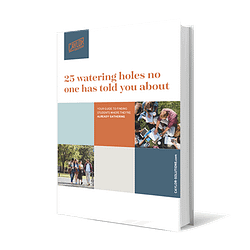
Then it’s time to look beyond the same crowded marketing channels everyone else is using. That’s why we want to share our new ebook: 25 Watering Holes No One Has Told You About. 
With this practical guide, you’ll discover how to:
- Identify overlooked digital and physical spaces where prospective students already gather
- Reach students and influencers in more authentic, relational ways
- Expand your recruitment strategy beyond traditional marketing plans
- Engage mission-fit students earlier in their decision-making journey
In short, you’ll gain a fresh roadmap for connecting with the right students—long before they ever fill out an application. Download your free ebook today!
images via chatgpt.com