
Higher Ed YouTube Marketing: How Colleges Build Trust Before the Campus Visit
Use higher ed YouTube marketing to build trust, show real campus life, and guide students before they visit.


Branding
Higher ed differentiation is getting harder.
Not because colleges and universities don’t have great things to offer. Most of them do.
They have committed faculty. Strong programs. Beautiful campuses. Caring communities. Meaningful student experiences. Championship moments. Alumni stories. Service opportunities. Mission statements that matter.
The problem is that prospective students and families are hearing a lot of the same language from a lot of different schools.
At some point, every college starts to sound like it has “world-class faculty,” “a close-knit community,” “hands-on learning,” and “a place where students thrive.”
Those things may all be true. But if everyone is saying them, they are not enough to make your institution stand out.
 That is why I enjoyed my conversation with Dr. Drew Flamm, President of Grace College and Grace Theological Seminary, so much.
Drew brings a unique perspective to the presidency because his background includes advancement, enrollment, marketing, public relations, fundraising, and strategic planning. He understands both the big-picture leadership side and the very practical execution side of enrollment growth.
In this episode of The Higher Ed Marketer podcast, recorded live at the CCCU International Forum, Drew shared how Grace College is building momentum by leaning into what makes the institution truly distinct: its Christian mission, its location in Winona Lake, Indiana, its relationship with the local community, and a leadership culture focused on execution.
And I think there is a powerful lesson here for Christian colleges and universities.
If you want to grow enrollment in a crowded market, you cannot simply tell students you are a good school.
You have to help them see why you are different.
For Grace College, higher ed differentiation begins with mission.
Drew talked about the importance of doubling down on Grace’s mission “to know Christ and to make Him known.”
That phrase is not just a statement on a wall. It is a filter for decision-making, storytelling, enrollment, and institutional identity.
That matters because mission-fit enrollment does not happen by accident.
Many schools are tempted to chase every possible student. I understand the pressure.
Enrollment goals are real. Budgets are tight. Demographic challenges are not theoretical anymore.
The temptation is to widen the net as much as possible and hope it catches enough students to make the numbers work.
Drew put it well when he explained that Grace is not trying to capture everyone. They are trying to capture the right students.
That is the heart of higher ed differentiation.
It is not about manufacturing something flashy. It is not about pretending to be something you are not.
It is about understanding what is already true about your institution and communicating it clearly enough, consistently enough, and courageously enough that the right students can recognize themselves in your story.
Drew said:
“And then selling what’s unique. Really thinking deeply about what makes us different and what makes us compelling to the market.
We’re not trying to capture, you know, as many, we’re trying to capture the right students. And so, doubling down on our mission—to know Christ and to make Him known—our vision that we’ve had historically, saying it over and over and over until you’re sick of saying it, and that’s probably when others are hearing it for the first time.
So, being clear, clear, clear on mission.”
That line about saying it until you are sick of saying it is so important.
We want to move on to the next campaign, the next slogan, the next creative concept. But consistency is what builds recognition.
If your mission is truly distinct, do not whisper it.
Repeat it.
Clarify it.
Show it.
Connect it to real student experiences.
Use it as the backbone of your enrollment strategy.
One of the most interesting parts of our conversation was Drew’s emphasis on place.
Grace College is located in Winona Lake, Indiana. And instead of treating location as a neutral detail, Grace is leaning into it as a core part of its brand.
Drew described Winona Lake as a safe resort town with coffee shops, skating rinks, boats, beaches, and a unique community feel. It is still in Indiana, but it offers something many prospective students may not expect.
That matters.
Too many colleges talk about location only in practical terms: driving distance, nearby cities, airport access, or weather. Those things are useful, but they do not always create emotional connection.
Can they see themselves walking downtown after class?
Can they imagine meeting friends at the coffee shop?
Can they feel the energy of the community?
Can they understand how the surrounding town or city will shape their college experience?
For Grace, Winona Lake is not just where the college happens to be. It is part of the experience. It is part of the story. It is part of the differentiation.
And yes, as we joked in the episode, Grace even has a branded speedboat.
That may sound like a small thing, but it is memorable. It makes people stop and say, “Wait, what kind of college has a boat?”

That is exactly the point.
In a crowded market, memorable matters.
Of course, not every institution has a lake. Not every school is in a resort town. Not every college has a speedboat.
But every institution is located somewhere. And that somewhere has a story.
There may be a local industry that creates career pathways for students. There may be cultural assets in the community.
There may be churches, nonprofits, businesses, schools, hospitals, or civic organizations that make your location more valuable than you realize.
Higher ed differentiation often begins when you stop comparing yourself to everyone else and start asking better questions about your own context.
What can students experience here that they cannot experience anywhere else?
What partnerships exist because of where we are?
What does our community make possible?
What does our location say about who we are?
Grace College has also made community engagement one of its core values.
That did not happen overnight.
Drew shared how, historically, there had been distance between the college and the local community.
Grace was once seen as “the city up on the hill,” separated from the town around it.
The community felt distant from the campus, and the campus felt somewhat separate from the community.
Over time, Grace College leadership worked intentionally to break down those barriers and build real partnerships.
Drew pointed to one of his predecessors, Dr. Ron Manahan, as a key figure in breaking down that barrier.
Grace is located near Warsaw, Indiana, which Drew described as “the orthopedic capital of the world.” Rather than ignoring that unique local context, Dr. Manahan began building relationships with executives from nearby orthopedic companies and asking what Grace and the community could do together.
As Drew explained:
“We’re in the orthopedic capital of the world, so if you have a knee or a hip or an elbow or a shoulder [orthopedic], it’s probably from Warsaw, Indiana.”
Drew went on to explain that those relationships eventually led to shared Grace/community facilities, including the use of historic buildings connected to both the college and the surrounding community.
That is the broader point.
Grace is not simply saying, “We care about community.” They are building facilities, creating partnerships, engaging local industries, and finding ways for students and faculty to make a tangible difference in the place where God has put them.
That is brand substance.
And in today’s higher ed environment, substance matters. Students and families are skeptical of generic claims. They want evidence. They want to know whether the experience you are promising is real.
For Christian colleges, this is especially important.
Faith-based education is not only about classroom instruction or chapel programming. It is about formation. It is about service. It is about loving your neighbor. It is about living out a mission in a real place with real people.
When a Christian college is deeply engaged in its local community, it gives prospective students a concrete picture of what faith in action looks like.
That is compelling.
One of the clearest takeaways from my conversation with Drew is this: if everyone can say it, it probably is not your strongest differentiator.
Drew made the point that most colleges have strong faculty. Most colleges have athletic teams. Most colleges have academic programs. Most colleges can talk about community.
That does not mean you should ignore those things. They may be important. They may be part of the cost of entry. But they are often not enough to separate you from your competitors.
Drew said:
“It’s a really good way to make a clarifying separation from you and your competitors, right?
So, all of us have amazing faculty, and yes, we want to talk about that. All of us have sports teams, and yes, we want to talk about that. We have programming on our campus that we do at high levels, and yes, we want to talk about that. But all of us have it, and it’s harder for the market to see the difference.
Where you’re located and what is happening around you and how you’re engaging it can be distinctly different.”
Your marketing should help a student understand not just that your institution is good, but why it is meaningfully different from the other schools on their list.
This is where many colleges struggle.
They look at competitors and try to match them point for point. Better residence halls. More programs. More student activities. More digital ads. More videos. More emails.
But sameness with more volume is still sameness.
For Grace, part of that is the integration of mission, place, and local impact. Drew talked about Grace’s centers of excellence, where faculty partner with students on research and projects that make a difference in the local community.
These centers focus on lakes and streams, health and well-being, and education, including reading scores in elementary schools.
That is not generic.
That is specific. It is tangible. It connects academic work to community need.
It gives prospective students a picture of how their education can matter now, not someday.
That kind of specificity is where great enrollment marketing lives.
Of course, even the strongest differentiator will not matter if the institution cannot execute.
Drew was clear that part of Grace’s enrollment momentum has come from operational discipline. He connected lessons from advancement to admissions and marketing: create a plan, make the calls, have the visits, make the asks, fill the funnel, and work the funnel.
That may not sound glamorous, but it is essential.
I have seen many institutions with good ideas struggle because they cannot turn those ideas into consistent action. They have the strategy document. They have the messaging platform. They have the campaign concept.
But they do not have the internal discipline to execute it week after week.
Grace has benefited from having both creative and operational leadership at the table. Drew described his Chief Marketing Officer as someone who thinks so far outside the box they are not sure there is a box, while his VP of Enrollment Management is a disciplined, list-following executor.
That combination is powerful.
You need both.
You need the people who can imagine something memorable, distinctive, and bold. And you need the people who make sure the funnel is being worked, the follow-up is happening, the data is being reviewed, and the plan is actually moving forward.
Higher ed differentiation is not just a messaging exercise. It is an institutional discipline.

Another thing I appreciated in Drew’s comments was the way he talked about technology.
Grace has worked to reduce unnecessary meetings and use tools to handle tasks that do not require hours of human discussion. That has freed up time for the work only humans can do: connecting with prospective students, donors, and current students in meaningful ways.
That is the right posture.
Technology should not remove humanity from enrollment marketing. It should protect it.
For Christian colleges especially, this is critical. We cannot talk about the imago Dei and then build systems that treat students like data points. We cannot claim to care about formation and then communicate in ways that feel cold, generic, or automated beyond recognition.
The goal is not to avoid technology. Rather, the goal is to use it wisely.
When technology handles repetitive tasks, your team has more room for conversation, discernment, hospitality, and personal connection.
That is where mission-fit enrollment happens.
The Christian college market is crowded, and the pressure is not going away.
But I do not believe the answer is to become more generic. I believe the answer is to become more honest, more focused, and more distinct.
That starts with asking hard questions:
The schools that will stand out in the years ahead are the ones willing to stop chasing sameness and start telling the truth about what makes them uniquely valuable to the right students.
Grace College is giving us a strong example of what higher ed differentiation can look like in practice: a clear Christian mission, a deep sense of place, meaningful community engagement, academic work tied to local impact, a healthy balance of creativity and execution, and a wise use of technology that creates more room for human connection.
That is a brand strategy worth paying attention to.
For even more insights from Dr. Flamm, listen to the full episode on The Higher Ed Marketer podcast.
Ready to Clarify What Makes Your Institution Different?
At Caylor Solutions, we help colleges and universities uncover, articulate, and communicate their true distinctives so they can connect with mission-fit students more effectively.
Whether your institution needs a stronger brand strategy, clearer enrollment messaging, better digital marketing, or a more compelling way to tell your story, our team can help you move beyond generic claims and build a marketing approach rooted in what is actually true about your school.
If your college is ready to stop sounding like everyone else, Caylor Solutions can help you identify what only you can offer and turn that into a strategy that supports enrollment growth.
Contact us today to learn more about how to boost your enrollment marketing results.
The essential marketing book every higher education institution needs! If you are a higher education marketing professional seeking a fail-safe plan to make your institution stand out, “Chasing Mission Fit” is your guide.
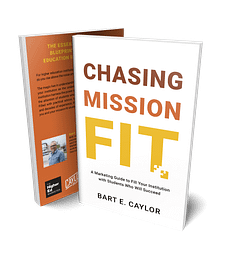 Discover how to:
So you can empower your institution with audience-focused marketing strategies, and attract mission-fit students who will flourish in your unique academic environment.
Ready to transform your institution’s marketing approach?
Order now!
Featured image via grace.edu






Subscribe to The Higher Ed Marketer podcast today!
Use higher ed YouTube marketing to build trust, show real campus life, and guide students before they visit.

Discover 10 actionable alumni engagement ideas that can strengthen your enrollment strategy and turn graduates into powerful brand advocates.

Use AI in college admissions outreach without losing student trust or human connection.