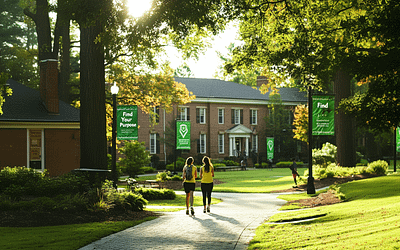
How Small Colleges Can Stand Out: Why Your Mission Is More Important than Ever
Learn how small colleges can stand out by using mission-fit marketing to attract the right students and increase enrollment effectively.


content marketing
AEO for online short-term programs may become one of the most important enrollment marketing conversations higher education leaders have over the next few years.
For more than two decades, colleges and universities have invested heavily in traditional SEO strategies to improve visibility in search engines.
We optimized webpages.
Built backlink strategies.
Refined metadata.
Improved page speed.
Chased Google rankings.
Because we understood one fundamental truth: if prospective students could not find us online, they could not enroll.
That reality has not changed.
But the way students discover information is changing rapidly.
Today’s prospective students are increasingly turning to tools like ChatGPT, Gemini, Perplexity, and Google’s AI-generated search summaries to explore career paths, compare credentials, and evaluate educational options.
“What’s the fastest way to become a data analyst?”
“Best online cybersecurity certificate for working adults.”
“What healthcare jobs can I train for in less than a year?”
“Can I finish a digital marketing credential while working full time?”
That shift matters for higher education marketers.
Especially for institutions offering online short-term programs.
Because when search becomes more answer-driven and conversational, visibility depends not only on whether your website ranks, but also on whether AI systems can confidently understand, trust, and recommend your programs.
That is where AEO enters the conversation.
A: AEO, or Answer Engine Optimization, is the process of creating content that AI-powered search tools can easily understand, trust, and surface in response to user questions.
For online short-term programs, AEO matters because prospective students increasingly search using conversational prompts like:
“Best online healthcare certificates for career changers”
“Affordable online IT programs under one year”
“Flexible programs for working adults”
Institutions that structure content clearly, answer real student questions, and demonstrate expertise are more likely to appear in AI-generated responses.
AEO does not replace SEO.
Instead, it builds on strong SEO foundations while emphasizing clarity, trust, structured content, and student-centered answers.
Some marketers are also beginning to use the term GEO — Generative Engine Optimization — alongside AEO. While the two concepts overlap, there is a subtle distinction.
AEO focuses specifically on optimizing content so AI systems can surface clear, direct answers to user questions. GEO, on the other hand, is the broader practice of improving visibility inside generative AI ecosystems like ChatGPT, Gemini, Claude, and Perplexity.
For higher education marketers, both concepts point to the same reality: discoverability is becoming increasingly AI-driven.
This is not simply a technical trend.
It is a shift in how prospective students discover and evaluate educational opportunities.
Traditional undergraduate enrollment journeys often move slowly.
Students may spend months, or even years, researching institutions, visiting campuses, comparing financial aid packages, and discussing options with family members.
Online short-term programs behave differently.
The prospective student searching for a certificate, workforce credential, or accelerated online program is often operating with urgency.
They are looking for:
Most importantly, they are actively searching for answers.
That makes online short-term programs uniquely aligned with the way AI search tools operate.
When someone asks ChatGPT:
“What are the best short-term healthcare certifications for career changers?”
…the institutions most likely to surface may not necessarily be the schools with the largest advertising budgets.
Increasingly, visibility depends on whether AI systems can clearly interpret:
That represents an important shift.
For years, higher ed marketers focused primarily on rankings.
Now we must also think about retrieval.
Not just whether students can find our content.
But whether AI systems can confidently recommend it.
One of the biggest misconceptions surrounding AI search is the idea that SEO is disappearing.
It is not.
Traditional SEO still matters tremendously.
AI systems continue to rely heavily on many foundational SEO signals, including:
But AI search environments place additional emphasis on:
Traditional SEO focused heavily on helping webpages rank.
That distinction matters.
AI systems are not simply indexing webpages.
They are synthesizing information from multiple sources to answer questions directly.
That means beautifully designed webpages alone are no longer enough if the underlying content is vague, generic, or difficult for AI systems to interpret.
Unfortunately, many higher ed websites still organize content around institutional structure instead of student intent.
I often see sites where pages are structured around:
Prospective students do not search that way.
They ask:
“Can I switch careers quickly?”
“What online credential helps me get promoted?”
“What jobs can I train for in under a year?”
“Can I complete this program while working full time?”
AEO requires institutions to organize content around those questions.
Not around internal organizational charts.
One of the most interesting aspects of AEO is that it may create opportunities for smaller institutions.
Historically, large universities held major advantages in traditional search because they possessed:
Those advantages still matter.

That creates opportunities for institutions with:
A regional university with a clearly articulated online workforce credential may become more discoverable than a nationally recognized institution with vague or generic program pages.
That matters for schools trying to grow:
In many ways, AI search environments may reward specialized expertise over broad institutional branding.
And that could fundamentally reshape how smaller institutions compete digitally.
One of the most important mindset shifts for enrollment marketers is recognizing that the student journey is becoming increasingly conversational.
Students no longer move neatly through a linear enrollment funnel.
Instead, they move through hundreds of micro-conversations across platforms.
A prospective adult learner may:
That means discoverability is no longer confined to your homepage or program pages.
AI systems increasingly evaluate signals from across the web, including:
AEO is not simply about optimizing webpages.
It is about building enough digital trust that AI systems repeatedly encounter your institution in credible, relevant contexts.
That changes how we think about content strategy.
Faculty expertise matters.
Student stories matter.
Alumni outcomes matter.
Structured FAQs matter.
Clear program descriptions matter.
And institutional distinctiveness matters more than ever.
One challenge many colleges may face in AI-driven search environments is institutional sameness.
Higher education marketing often relies on generic language:
The problem is not that these phrases are wrong.
The problem is that nearly every institution says the same thing.
That means differentiation becomes increasingly important.
Institutions that clearly articulate:
…may become easier for AI systems to retrieve and recommend.
This is where mission-fit marketing becomes especially powerful.
Distinctiveness is no longer just a branding advantage.
It may become a discoverability advantage.
One of the biggest misconceptions about AEO is that it is purely technical.
At its core, AEO is deeply connected to trust.
AI systems are attempting to identify and surface the most useful, relevant, and credible answers available.
That means institutions that consistently publish:
…are more likely to become trusted sources within AI-generated responses.
Higher education institutions already possess tremendous authority.
They have:
The challenge is not expertise.
The challenge is accessibility.
Too often, colleges bury valuable expertise beneath:
AEO forces institutions to simplify communication.
Not dumb it down.
Simplify it.
The schools that explain complex educational pathways clearly and conversationally may gain significant visibility advantages in AI search environments.

One important strategic reality higher ed marketers need to prepare for is that AI search may reduce traditional website traffic.
Students may increasingly receive answers directly inside AI tools without clicking through to institutional websites.
That can feel alarming.
But lower traffic does not necessarily mean lower effectiveness.
In fact, AI search may produce:
The goal may no longer be maximizing raw traffic.
The goal may become maximizing trusted visibility during high-intent decision moments.
That is an important mindset shift for institutional leaders who still evaluate success primarily through pageviews or broad awareness metrics.
As institutions begin exploring AEO, the conversation should start with strategy before tactics.
Questions worth discussing include:
These are no longer simply SEO questions.
They are enrollment strategy questions.
Brand positioning questions.
Student experience questions.
And increasingly, competitive positioning questions.
Every major digital shift in higher education creates hesitation.
We saw it with social media, mobile-first design, CRM adoption, digital advertising, and online learning.
The institutions that adapted early often built lasting advantages.
The same may prove true with AEO.
Prospective students are already using AI tools to explore educational pathways.
The question is not whether AI search will influence enrollment marketing.
It already is.
For online short-term programs, the opportunity may be especially significant.
These programs align naturally with:
That makes them one of the clearest proving grounds for AEO in higher education.
The institutions that respond early may not simply improve discoverability.
They may position themselves as trusted educational authorities within the next generation of digital search.
Build an AEO Strategy Before Your Institution Falls Behind
AI search is changing how prospective students discover educational opportunities.
But most higher ed marketing teams are still trying to figure out what that means strategically.
At Caylor Solutions, we help colleges and universities build mission-fit marketing strategies that adapt to changing student behavior without losing institutional authenticity.
From content strategy and enrollment marketing audits to AI masterclasses and digital visibility consulting, our team helps institutions create clearer, more student-centered marketing ecosystems built for the future of search.
If your institution is exploring how AEO, GEO, and AI-driven discovery may impact enrollment growth, we would love to help you think strategically about what comes next.
It might be time to redesign your enrollment website to get the results you’re looking for.
Download our free Guide to Website Redesign Planning to learn more about how to fix the most common problems school websites have.
 In this guide, you’ll explore how to…
Don’t revamp your website before you check out our free Guide to Website Redesign Planning!
And if you want to go deeper to see how much more you can get out of your enrollment website, contact us for a consultation and a digital marketing audit.
images via chatgpt


Subscribe to The Higher Ed Marketer podcast today!
Learn how small colleges can stand out by using mission-fit marketing to attract the right students and increase enrollment effectively.

Higher ed affordability myths cause 55% of students to rule out colleges early. Learn how to fix cost perception before the inquiry stage.

Discover proven Hispanic student recruitment strategies that boost enrollment, from bilingual marketing to community engagement.