
Enrollment Leadership Development: Preparing the Next Generation
Discover why enrollment leadership development is essential to building stronger teams, retaining top talent, and preparing future higher ed leaders.


Branding
If you work in higher education long enough, you’ll eventually find yourself in a late-night conversation about U.S. News College Rankings.
You’ve either celebrated them, or you’ve resented them.
And now, in 2026, the conversation has shifted again.
With AI-driven college search tools like ChatGPT, Gemini, and other large language models summarizing institutions in seconds, some marketers are asking:
Do U.S. News college rankings still matter?
 After our recent conversation with Nate Mouttet, Senior Director of University Partnerships at U.S. News and World Report, my answer is clear:
Yes. They still matter.
But perhaps not for the reasons you think.
U.S. News didn’t invent the comparison game. But they did organize it and give it some rules.
Back in the 1980s, before search engines, before social media, and certainly before AI, families relied heavily on word-of-mouth.
If your uncle said a school was strong in engineering, that carried weight. If your pastor recommended a college, that mattered.
U.S. News entered that fragmented landscape with a clear, enduring mission:
“The mission of U.S. News is to help consumers make informed decisions.”
Rankings were never intended to be a popularity contest.
They were an attempt to aggregate public data—graduation rates, faculty resources, institutional outcomes—and present them in a format families could understand.
Over the decades, methodology evolved. And today, roughly half of a Best Colleges ranking weight is tied to outcomes such as:
When U.S. News began organizing this data in the 1980s, it filled a real gap.
Gathering, organizing, and interpreting institutional data wasn’t easy. Families didn’t have dashboards in their pockets. They had word-of-mouth and whatever printed guide they could find.
Today, answers come faster. AI tools can summarize an institution in seconds.
But speed doesn’t equal trust.
In a world where confidence in institutions continues to fragment, trusted third-party aggregators still carry cultural weight.
When families see data validated outside the university’s own marketing language, it reinforces credibility.
It doesn’t replace the institution’s voice — it strengthens it.

Let’s talk about what’s really changed.
Students are no longer flipping through printed guides in the grocery store line. They’re asking AI tools questions like:
Large language models are incredibly good at summarizing.
But here’s the catch:
They don’t invent authority. They aggregate it.
They lean heavily on structured, public, trusted data sets. They look for consistency across domains.
That’s where U.S. News college rankings still matter.
If your institution has a strong profile on an authoritative third-party domain, that profile becomes part of the AI training and retrieval ecosystem.
In other words, rankings are no longer just about prestige.
They’re about digital visibility infrastructure.
Traditional SEO (search engine optimization) has always been built on three pillars:
Now we’re adding a fourth concept: GEO — generative engine optimization.
In this new landscape, authoritative backlinks matter more than ever.
When Nate described U.S. News as a “lightning rod” that draws massive visibility (six million visitors on ranking release day alone), what he was really describing is domain authority at scale.
You’re strengthening:
That’s not superficial. That’s strategic.
Too many institutions do this:
That’s the bare minimum.
Nate shared a pragmatic recommendation that I wholeheartedly agree with:
“Every campus that has ranking on U.S. News needs to own that page. They need to take advantage of it.”
Owning that page means:
Your ranking profile is not a static data sheet.
It’s a marketing asset.
Beyond the rankings themselves, U.S. News has tools like Academic Insights that tap into decades of longitudinal proprietary data.
And this is where things get really interesting.
If you’ve worked on a campus long enough, you’ve sat in a meeting where a president or provost says something like, “Our real competitors are X and Y,” or “We should be benchmarking against this institution,” or “We’re stronger in this area than people realize.”
Sometimes they’re right.
Sometimes… they’re aspirational.
And more often than not, it’s the marketing leader in the room who’s quietly thinking, We need data to ground this conversation.
Instead of commissioning a custom research project or relying on fragmented comparisons, you can access structured, apples-to-apples benchmarking built on more than 40 years of consistent data collection.
That kind of clarity changes conversations by…
And in an AI-driven college search environment, where perception spreads faster than ever, clarity about your true market position isn’t optional.
It’s foundational.
One of the most fascinating parts of our conversation was the research U.S. News presented at AMA.
Instead of speculating about how AI might change the college search process, they asked students directly how they’re using it.
And the answers were telling.
Students aren’t just typing in “best colleges” and stopping there. They are…
What they’re really trying to do is surface the intangibles — the feel of a place — in a way that would have taken hours of browsing just a few years ago.
They’re essentially asking AI to do what guidance counselors, guidebooks, rankings, social media, and campus tours used to do separately.
And here’s what’s really happening under the hood: AI is aggregating everything it can find.
It pulls from TikTok impressions, review platforms, official institutional data, rankings, third-party articles, and then it synthesizes all of it into a clean summary.
And students are trusting that summary.
That should get our attention.
Rather, it will quietly surface it.
On the other hand, if your authoritative third-party presence is strong — if your data is consistent, structured, and credible — AI will amplify that credibility.
AI isn’t replacing rankings.
It’s redistributing them.

Nate said something in our conversation that deserves to be repeated:
“Universities are content farms that no one has really ever learned how to harvest.”
Sit with that for a moment.
Inside your institution, there is an extraordinary amount of content being created every single day.
Faculty are conducting research. Professors are shaping syllabi. Students are telling stories through projects, performances, and service.
Alumni are landing jobs, launching companies, and making an impact in their communities.
Outcomes data is being collected. Events are happening weekly.
In an AI-driven college search ecosystem, that’s a problem.
Unstructured content is invisible.
If it’s buried in PDFs, hidden in old web pages, or scattered across disconnected platforms, AI won’t elevate it. It will move past it.
But structured, authoritative, and distributed content? That gets amplified.
That includes your:
All of it contributes to the digital footprint that AI summarizes.
If you don’t tend your digital garden, AI will summarize whatever it can find — whether that’s the story you intended to tell or not.
Yes. But not as the sole determinant of quality.
U.S. News college rankings still matter because they remain culturally recognizable.
When families begin researching colleges, rankings are one of the few reference points that feel familiar and standardized.
They function as trusted third-party validators in a space where institutions are, understandably, telling their own stories.
They also carry enormous digital weight.
From a marketing standpoint, rankings live on high-authority domains, influence how institutions are summarized in AI-generated responses, and strengthen both traditional SEO and emerging GEO strategies.
That kind of structured, consistent data doesn’t just sit on a page. It feeds the broader information ecosystem.
In a fragmented information environment, trusted aggregation platforms become stabilizing forces. And in an AI-driven search environment, structured authority becomes fuel.
Rankings aren’t just about bragging rights anymore.
They’re about infrastructure.
At the end of our conversation, Troy asked Nate for one piece of advice that leaders could implement immediately.
Nate didn’t hesitate.
Every campus that has a ranking on US News needs to own that page. They need to take advantage of it.
But don’t own it like a trophy, badge, or a press release moment.
Own it as part of your visibility strategy.
If your institution is ranked, that page already exists. It already carries authority that receives traffic.
The question is whether you are intentionally leveraging it as part of your broader SEO and GEO ecosystem.
Nate described U.S. News as a kind of “lightning rod,” drawing attention at scale and redistributing it.
Marketing leaders have an opportunity to treat that visibility as a multiplier rather than a moment.
And in an AI-driven college search environment, multipliers matter.
For even more insights from Nate Mouttet, listen to the full episode on The Higher Ed Marketer podcast.
If Rankings Are Infrastructure, You Need an Audit
Most institutions aren’t losing visibility because they lack good stories. They’re losing visibility because their digital ecosystem isn’t aligned.
Here are some common misalignments:
And in an AI-driven college search environment, those gaps compound quickly.
We conduct a thorough review of your institution’s marketing ecosystem from digital presence and content effectiveness to competitive positioning and enrollment strategy alignment.
Then we deliver clear, actionable recommendations that help you strengthen visibility, clarify messaging, and compete more effectively.
Your marketing audit will help ensure your institution shows up accurately, authoritatively, and strategically wherever students are searching — whether that’s Google, Gemini, ChatGPT, or a trusted third-party platform like U.S. News.
If you suspect your visibility strategy hasn’t kept pace with AI-driven search, now is the time to find out.
Contact us today to see how we can help you with a marketing audit.
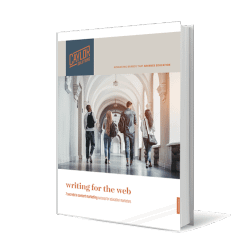
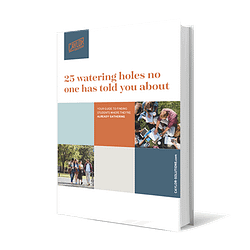
Then it’s time to look beyond the same crowded marketing channels everyone else is using. That’s why we want to share our new ebook: 25 Watering Holes No One Has Told You About. 
With this practical guide, you’ll discover how to:
In short, you’ll gain a fresh roadmap for connecting with the right students—long before they ever fill out an application. Download your free ebook today!
Featured image via usnews.com
Other image via chatgpt and Gemini



Subscribe to The Higher Ed Marketer podcast today!
Discover why enrollment leadership development is essential to building stronger teams, retaining top talent, and preparing future higher ed leaders.

See where AI admissions support can save time, strengthen communication, and help teams without replacing human judgment.
Discover a practical higher ed change management framework for knowing when to push, pull, or pause while leading through institutional change.