
Enrollment Innovation Before the Funnel: Reaching Students Where They Already Are
Discover how Houston Christian University uses enrollment innovation, digital high school billboards, and direct admission to reach students before the funnel.


Featured
An AI marketing readiness checklist helps small colleges evaluate their goals, data systems, team capabilities, and tool strategies before integrating AI into their marketing workflows.
By now, we’ve all heard that “AI is the future!” To me, there’s no doubt that this is most certainly true.
Generative AI tools have quickly become some of the most powerful assets available to higher ed marketers.
What used to take hours—writing blog posts, summarizing data, drafting emails, brainstorming messaging—can now be done in minutes.
But that doesn’t mean AI removes the need for human strategy and storytelling. It means your team can finally get back to focusing on those things.
At Caylor Solutions, we work with small colleges every day.
We know you’re not flush with budget or staff. You wear multiple hats. You’re asked to do more with less.
At the same time, you’re constantly trying to stay relevant in a fast-changing marketing environment.
That’s exactly why AI can be a game-changer.
Used wisely, AI can help you:
And all of this can be done without adding too much to your budget or staff count.
It’s really amazing what higher ed marketing teams can do with AI tools.
If small colleges fail to adopt AI in a thoughtful and strategic way, they risk implementing tools in a haphazard manner—leading to confusion, wasted time, and inconsistent messaging that may damage credibility with prospective students and donors.
This is exactly what’s happening at many organizations that rushed into AI adoption without a clear plan.
As TechSpot reports, some companies are now reversing course and rehiring staff they initially replaced with AI after realizing the tools couldn’t deliver as expected.
Larger organizations often have the resources and infrastructure to recover from these kinds of missteps. But small colleges don’t.
Without that same margin for error, a rushed or ill-considered AI rollout can lead to wasted resources, internal confusion, and diminished trust among students, families, and donors—consequences that are much harder to overcome.
Without clear strategy and oversight, colleges may misuse AI and get worse results than they anticipated.
If you’re not intentional and clear about how to use generative AI tools, you’ll get content that sounds formulaic and lacks emotional resonance.
It may also fail to reflect the institution’s unique voice or values.
Instead of reinforcing your brand, this kind of generic output can actually dilute it. That can lead to confusion among prospective students and donors.
Over time, this erosion of brand trust makes it much harder to connect with mission-fit audiences and stand out in a crowded higher ed marketplace.
That’s why the question isn’t if small colleges should use AI.
It’s how they should start and how to do it wisely.
That’s where the AI marketing readiness checklist comes in.
Start with the outcomes you care about the most. Don’t implement AI because everyone else is doing it.
Get specific about why you want AI in the first place and what problems it should solve.
Clarifying your goals sets the tone for every decision that follows.
It helps you avoid chasing shiny tools and instead focus on strategic use cases that truly support your enrollment, advancement, and brand objectives.
Define the purpose clearly:
This clarity helps you avoid random acts of marketing and instead build a focused, purpose-driven AI strategy that supports enrollment and advancement.

AI tools work best when they have strong inputs. That includes past blog posts, campaign materials, and clear data on what your audiences respond to.
The stronger and more organized your inputs are, the more accurate, personalized, and on-brand your AI outputs will be.
When your content library is robust and your data is clean, AI can identify patterns, surface insights, and generate highly relevant messaging.
But if your inputs are scattered, outdated, or inconsistent, AI will mirror that disorganization resulting in weaker content and less effective campaigns.
Before adding new tools, assess:
If the answer is no, it’s worth investing time in organizing what you already have. AI can scale your efforts, but only if your foundation is solid.
A: Small colleges should prepare for AI by clarifying their goals, auditing their content and data systems, training their team, and selecting tools that solve real problems. A structured AI marketing readiness checklist ensures adoption is strategic and sustainable.
AI can dramatically increase your team’s capacity, but not everyone is ready to jump in.
Some team members may feel unsure about how AI works, while others may worry that it will replace parts of their role.
Others simply haven’t had the time or support to explore the tools in a meaningful way.
Recognizing these tensions early helps you create a safe, structured environment where your team can learn, experiment, and build confidence at a manageable pace.
Adoption works best when your team feels empowered, not threatened.
The best tools are the ones that solve real problems—not just the ones getting the most buzz.
The goal is to select tools that genuinely reduce workload, strengthen communication, and improve efficiency.
For small colleges, that often means choosing platforms that are affordable, easy to learn, and adaptable to your existing systems.
The right tool should feel like an extension of your team, not another item on your to‑learn list.
Here are a few examples tailored to small college marketing workflows:
Start small. Pick one workflow to optimize—like repurposing blog content into social posts—and build from there.
A: The tools needed for AI adoption vary by team, but most small colleges benefit from AI writing tools, research assistants, SEO optimization platforms, and social media automation tools. The key is choosing tools that are affordable, easy to learn, and aligned with your goals.
AI tools can sound generic or off-brand without human oversight.
Without clear direction, they tend to default to vague, overly polished language that doesn’t capture the heart of your institution.
This is why brand oversight is essential. Before you put AI to work, take time to articulate exactly how your school should sound across all channels.
To protect your school’s identity, define your brand voice:
A simple style guide or brand voice document goes a long way in keeping things consistent.

AI should support your goals, not distract from them. It’s easy for teams to get excited about new tools and lose sight of what matters most.
That’s why intentional alignment is crucial.
AI works best when it amplifies your existing strategies rather than pulling your team in new or unnecessary directions.
When used well, AI becomes a powerful ally helping you move faster, stay consistent, and keep your mission at the center of every communication.
Make a plan for:
This ensures that AI becomes a collaborator, not a competitor.
Take the Next Step with Caylor Solutions Consulting Services
If reading through this AI Marketing Readiness Checklist has shown you that your team needs clearer strategy, better alignment, or more confident leadership in your AI adoption—you’re not alone.
Many small colleges are feeling the pressure to modernize quickly, but they don’t have the margins to make costly missteps. That’s exactly where Caylor Solutions Consulting Services can help.
Our consulting solutions are designed to give small and mid-sized institutions the strategic clarity, leadership, and coaching they need to use AI—and every other part of their marketing—wisely, efficiently, and confidently.
Our team works alongside yours to strengthen:
Whether you need senior-level guidance or hands-on support, we offer flexible options to meet you where you are.
Your institution doesn’t need to navigate AI adoption alone—or guess your way through a rapidly changing landscape.
With Caylor Solutions at your side, you can build a marketing engine that’s:
👉 If you’re ready to strengthen your strategy and guide your team toward smart, sustainable AI adoption, our consulting services can help you get there. Let’s talk.
The essential marketing book every higher education institution needs! If you are a higher education marketing professional seeking a fail-safe plan to make your institution stand out, “Chasing Mission Fit” is your guide.
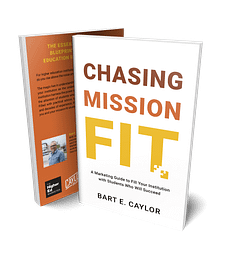 Discover how to:
So you can empower your institution with audience-focused marketing strategies, and attract mission-fit students who will flourish in your unique academic environment.
Ready to transform your institution’s marketing approach?
Order now!
Images via Midjourney



Subscribe to The Higher Ed Marketer podcast today!
Discover how Houston Christian University uses enrollment innovation, digital high school billboards, and direct admission to reach students before the funnel.

Learn how to evaluate fall enrollment results using metrics that reveal conversion, student fit, financial health, and next steps.

Build trust in higher education marketing with authentic stories, clear outcomes, and consistent messaging that helps prospective students confidently choose your institution.