
AI in Enrollment Reporting: Turning Data Into Insight (Not Noise)
AI enrollment reporting helps colleges find trends, reduce reporting overload, and make better decisions without replacing human judgment.


Branding
Faith-based college marketing isn’t just about faith. It’s also about having a focused strategy on cultivating relationships with mission-fit students for your school.
In today’s higher ed environment, Christian colleges and universities face a unique dual challenge: staying true to their spiritual mission while competing in a noisy, competitive recruitment landscape.
Budget constraints, enrollment pressures, and cultural shifts are testing institutional resilience like never before.
Yet within these challenges lies a distinct advantage.
Over decades of working with Christian colleges, I’ve seen that the most successful institutions are the ones that lean into their mission-driven strategies to sharpen their brand presence and attract the students they’re uniquely designed to serve.
This post draws from my decades of experience working with Christian institutions to share practical, mission-driven marketing strategies that work.
Faith-based institutions don’t need glossier brochures or flashier websites.
They need clarity.
When a college leads with its mission (more so than its academic programs) it stands out in an oversaturated market.
Alignment across faculty, chapel programming, campus life, and communications is more powerful than aesthetics alone.
It builds trust with prospective students and their families who are seeking more than academic excellence. They’re looking for belonging and purpose.
In this article by Modern Campus, the authors advise schools to “be as authentic as possible” when showcasing campus life, warning against staged or stock photos.
I couldn’t agree more! In my own work with Christian colleges, I’ve consistently seen how students and families are drawn to institutions that clearly articulate what they stand for spiritually, academically, and culturally.
When a school’s message reflects its mission in both tone and substance, it doesn’t just earn attention; it earns trust.
That trust becomes the foundation for deeper engagement, stronger yield, and lasting brand affinity.
Marketing shouldn’t just reflect institutional leadership.
It should reflect a shared voice across your entire campus community.
That means inviting student stories, chapel reflections, alumni testimonies, and faculty insights into your brand storytelling.
When everyone speaks from the same faith-based values, your message becomes both louder and more believable.

Many faith-based colleges are rediscovering the power of church partnerships to reach mission-fit students.
Whether through referral programs, speaking engagements, youth group collaborations, or Christian school networks, these partnerships offer trusted, value-aligned pipelines that outperform general marketing in both yield and cost-efficiency.
Church partnerships should be seen as more than historical sentiment. They provide a strategic enrollment path forward.
A: Christian colleges can attract more mission-fit students by aligning their marketing with their core spiritual mission. This includes telling authentic stories of student transformation, using digital tools to measure what content performs best, and reaching students through trusted communities like churches and Christian schools. Clarity and purpose in messaging lead to deeper connections and stronger enrollment outcomes.
Alumni engagement should be more than an asset for the alumni department because your alumni are a strategic recruitment asset too.
When alumni share their stories, refer students, or speak at events, they provide compelling proof that your institution delivers on its promises.
Christian colleges can cultivate their graduates as active partners in enrollment growth.
Christian institutions seeing success with Gen Z aren’t louder–they are more honest.
According to Barna Group, today’s students value transparency, inclusion, and authenticity.
Prospective students resonate more deeply with content that feels lived-in and unscripted. Rather than slick promotional videos, they’re moved by a student’s unscripted thoughts on how their faith grew in the dorm or a spontaneous chapel moment shared on Instagram.
User-generated content, day-in-the-life student reels, and informal Q&As with faculty create a sense of real connection.
More than just engaging your audience, student-created content can act as a trust-building tool.
When students see people like themselves expressing honest questions, faith experiences, and community stories, it invites them to imagine their own place on your campus.
This authenticity is central to how Gen Z explores, evaluates, and chooses their college experience. Learn more in our guide to marketing to Gen Z.
Faith-based colleges today are grappling with several compounding challenges: a shrinking pool of college-age students, increased skepticism toward higher education, rising tuition costs, and a cultural shift away from organized religion (Pew Research).
At the same time, Gen Z students are demanding greater transparency, personalization, and alignment with their values.
Besides that, another Pew study shows that there is a sudden resurgence of personal faith and religious attendance among Generation Z.
So what does that mean?
That means:
When you market from a place of clarity and conviction, you don’t just stand out, you resonate with students who are looking specifically for a place like yours.
What content resonates? Which campaigns convert?
To answer these questions with confidence, faith-based colleges must adopt a data-driven approach to marketing.
That begins with regular A/B split testing—a simple yet powerful way to compare different versions of your emails, ads, or landing pages to determine which approach yields better results.
Beyond testing, tracking key metrics across digital platforms is essential. For email marketing, tools like Mailchimp, Constant Contact, and HubSpot offer robust analytics that reveal open rates, click-through rates, and conversion paths.
For social media, platforms like Meta Business Suite, Hootsuite, and Sprout Social can help you monitor engagement trends and audience growth.
Google Analytics and newer GA4 dashboards remain the gold standard for website traffic insights, while ad platforms like Google Ads and Facebook Ads Manager offer granular conversion tracking.
AI tools can now identify patterns in your audience behavior, recommend content optimizations, predict the success of campaigns, and even generate performance reports in natural language.
Solutions like Jasper, HubSpot AI, and Adobe Sensei are helping marketers turn data into actionable insights faster than ever before.
This kind of intentional measurement transforms marketing from guesswork into strategy.
By tracking what your audience responds to—from faith-centered blog posts to testimony videos or financial aid messaging—you can continually refine your content and improve results.
Faith-based marketing, when built on a foundation of analytics and insight, becomes measurable and scalable.

Prospective students want to know: Will I belong here?
That question is answered best through the real experiences of real people like your prospective student.
This is the kind of story-driven content that connects.
A: AI helps faith-based colleges improve marketing by offering insights into what works. Tools powered by AI can track student engagement, predict campaign performance, and personalize content for different audiences. Used wisely, AI supports the mission—not replaces it—by helping teams focus on strategies that truly connect with students.
As more student research takes place through generative AI and search engines, your content must be structured to be findable.
That means FAQs, mission statements, and student testimonies need to be written in natural language and optimized for Generative Engine Optimization (GEO).
When you combine authentic stories with technical excellence, you boost both visibility and trust.
For more, see our post on using AI in content marketing.
In a competitive market, your faith identity isn’t a constraint.
It’s your greatest advantage.
When Christian colleges collaborate, share, and learn from one another, we all move forward.
Let’s build a community of practice that elevates faith-based college marketing and helps more students discover the place where they belong.
Feel like a lot? We can help!
You know that faith-based college marketing requires more than messaging. It requires a disciplined, strategic approach guided by the right questions and the right metrics.
It requires deep alignment with your mission.
Our consulting services are designed to meet you where you are and take your team to the next level.
Whether you need high-level strategic planning, support for enrollment marketing processes, or practical guidance on integrating AI responsibly, we offer services tailored to your needs:
We help your institution build a marketing strategy that not only reflects your values—but also delivers results that are measurable and sustainable.
From strategic consulting to creative execution, we empower faith-based institutions to articulate and amplify what makes them unique.
Need a partner to amplify your mission? Let’s talk.
The essential marketing book every higher education institution needs! If you are a higher education marketing professional seeking a fail-safe plan to make your institution stand out, “Chasing Mission Fit” is your guide.
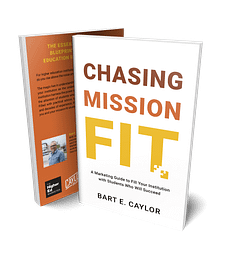 Discover how to:
So you can empower your institution with audience-focused marketing strategies, and attract mission-fit students who will flourish in your unique academic environment.
Ready to transform your institution’s marketing approach?
Order now!
Images via Midjourney



Subscribe to The Higher Ed Marketer podcast today!
AI enrollment reporting helps colleges find trends, reduce reporting overload, and make better decisions without replacing human judgment.

Learn how personal branding for higher ed leaders can strengthen institutional trust, expand reach on LinkedIn, and build stronger connections with key audiences.

Mission-fit adult enrollment starts with clarity, relevance, and trust. Learn how to reach adult and graduate students more effectively.