
Websites that Work Harder: Website Optimization for Higher Ed
Learn how strategic UX and AI-driven website optimization for higher ed can transform your site from a brochure into a high-converting enrollment tool.



Uncategorized
A strong higher education fundraising strategy is often discussed in terms of numbers—annual totals, campaign goals, donor counts, and participation rates.
But after more than three decades in advancement, Terry Munday would be the first to tell you that it’s never just the money.
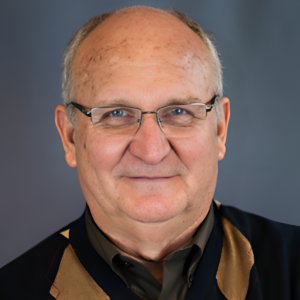 In this episode of The Higher Ed Marketer podcast, Troy Singer and I sat down with Terry Munday, Assistant to the President at Indiana Wesleyan University and a donor development expert with more than 35 years of experience in advancement.
What unfolded was a masterclass in higher education fundraising strategy rooted not in tactics alone, but in relationships, trust, patience, and mission.
This conversation reinforced something I’ve seen time and time again in enrollment and advancement work.
Institutions that build a culture of generosity don’t chase gifts—they steward people.
And when you do that well, annual fund donors don’t just give once.
Over time, they become partners, advocates, and eventually legacy givers.
Early in our conversation, Terry shared what he calls the “3C Principle” of fundraising.
“There’s one key thing in fundraising, and it’s what I call the 3C principle: see the people, see the people, see the people.”
It sounds simple.
But it’s remarkably countercultural in a profession that can become overly focused on portfolios, moves management, and metrics.
Terry’s point was clear.
When donors feel seen as people—not wallets—generosity follows naturally.
Throughout his career, Terry never judged donors by appearances, homes, or lifestyles.
One of the most powerful stories he shared involved donors who lived extraordinarily frugal lives while quietly giving tens of thousands of dollars every year to support students.
Eventually, their generosity culminated in a multi-million-dollar estate gift.
That kind of generosity doesn’t come from slick campaigns.
It comes from trust built over time.
One of the most practical takeaways from this episode was Terry’s emphasis on the annual fund as the backbone of any strong higher education fundraising strategy.
Too often, institutions treat the annual fund as an afterthought.
It becomes something to be maintained while attention shifts to major gifts or capital campaigns.
Terry sees it very differently.
The annual fund is unrestricted giving.
It’s flexible.
It’s responsive.
And most importantly, it’s where relationships begin.
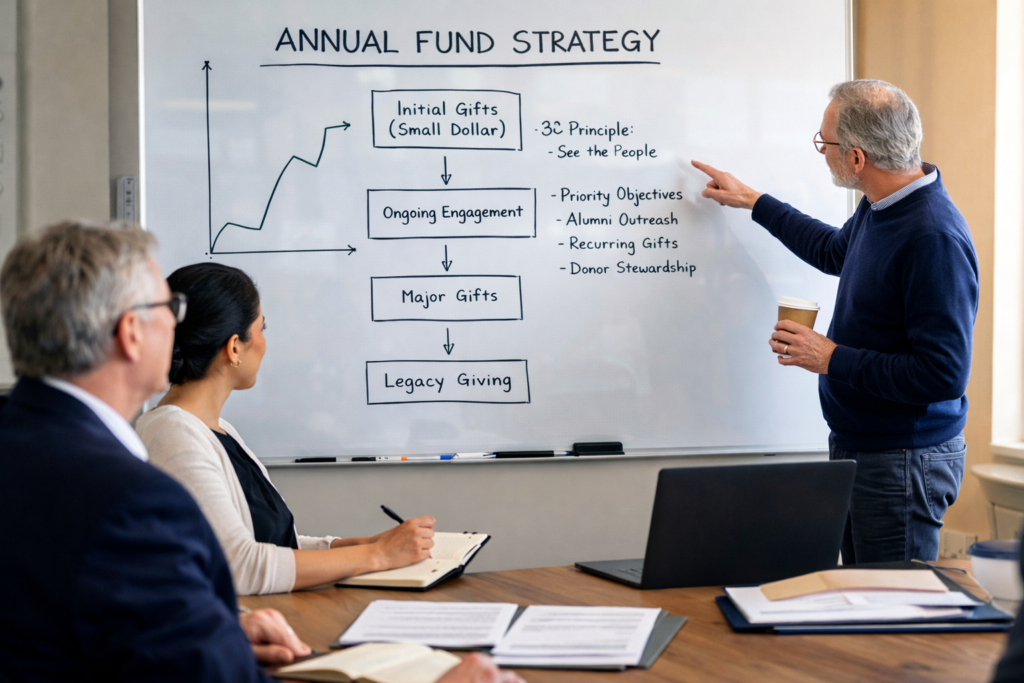
Terry explained that many of the largest gifts he ever received started with donors who gave modestly—$100, $250, or $1,000—year after year.
Those early gifts weren’t about capacity.
They were about commitment.
With consistent stewardship, those donors grew in both confidence and generosity.
The annual fund creates the on-ramp for deeper engagement.
It allows donors to say yes early, experience the impact of their giving, and build trust in the institution’s leadership and mission.
One of the most refreshing parts of this conversation was Terry’s honesty about asking.
In fundraising circles, we often talk about cultivation.
Sometimes we talk about it so much that asking feels uncomfortable or even avoided.
Terry doesn’t dismiss cultivation.
He reframes it.
“You can’t cultivate, cultivate, cultivate, and never get to the ask. You’ve got to eventually get to the point where you ask.”
He shared research that reinforces this reality.
But relationships only work when there’s clarity and courage.
Terry emphasized that most major donors didn’t start with major gifts.
Many of them gave 15 to 20 smaller gifts before making a transformational one.
The role of advancement leaders is not to rush that process.
It’s to walk faithfully with donors through it.
That requires patience.
Confidence.
And a willingness to trust the long game.
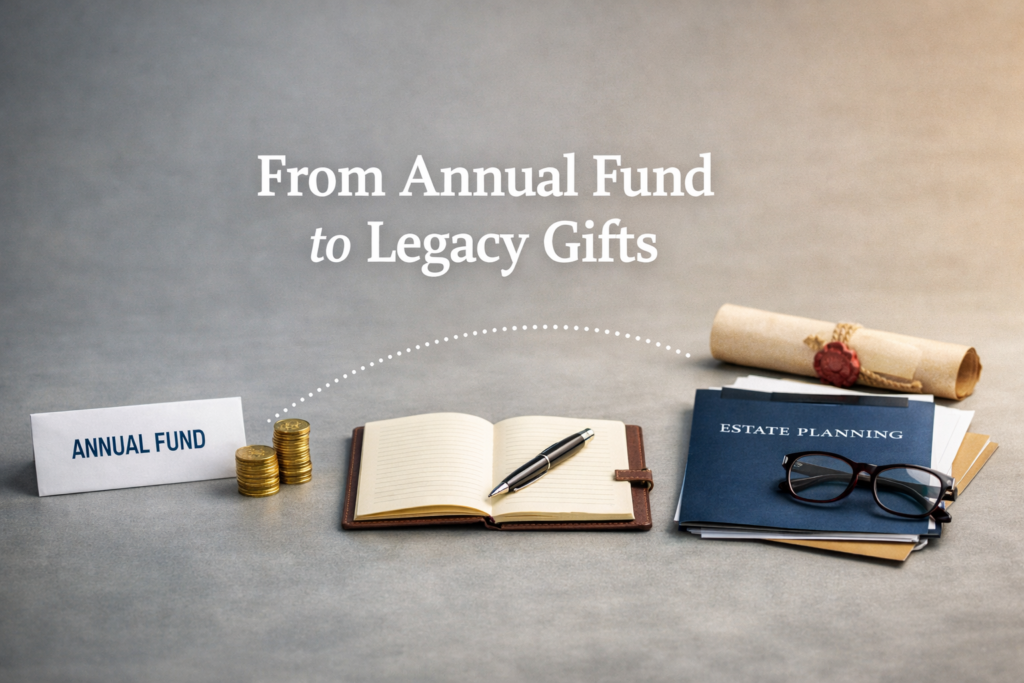
One of the most compelling frameworks Terry shared was how annual fund engagement naturally leads to legacy giving when handled well.
The progression looks something like this:
Terry shared multiple stories where a simple annual fund follow-up call uncovered far greater generosity than anyone expected.
In one case, a donor who had simply forgotten to send his annual gift ended up donating land that ultimately turned into more than a million dollars for student scholarships.
That’s not luck.
That’s attentiveness.
Annual fund calls, stewardship conversations, and personal follow-ups aren’t administrative tasks.
They’re opportunities.
And when advancement teams treat them that way, the results can be extraordinary.

One of the most moving moments in the episode came when Terry reflected on the true role of advancement leaders.
“A lot of times they call us vice presidents for advancement or directors of development, when in fact what we are… are pastors.”
That statement stopped me in my tracks.
Fundraising leaders often walk with donors through life’s most significant moments.
Illness. Loss. Legacy planning. Faith decisions.
Terry shared deeply personal stories of donors whose generosity was intertwined with their spiritual journeys and life transitions.
This pastoral posture doesn’t mean advancement professionals replace clergy.
It means they bring empathy, compassion, and presence into their work.
They show up when it matters.
They listen.
And they care about people beyond the gift.
That’s how generosity becomes transformational rather than transactional.
Over 35 years in advancement, Terry identified several leadership traits that separate great fundraisers from good ones:
One of the most important points Terry made was about tenure.
Fundraising is relational work. Relationships take time.
Institutions that expect advancement leaders to produce major results in two or three years are setting themselves up for disappointment.
Trust compounds over time. So does generosity.
Toward the end of the episode, Terry highlighted a reality that should be front and center for every advancement leader.
Seventy percent of the wealth in the United States is currently held by Baby Boomers.
Over the next few decades, trillions of dollars will transfer to the next generation.
Institutions that build relationships now—through annual fund engagement, stewardship, and trust—will be positioned to receive legacy gifts that shape their futures.
Those that don’t will miss one of the greatest philanthropic opportunities in history.
The window is open.
But it won’t stay open forever.
If there’s one takeaway from this conversation, it’s this: Strong higher education fundraising strategy isn’t about chasing dollars. It’s about cultivating people.
Annual funds matter because they invite participation. Relationships matter because they build trust.
Legacy gifts happen when donors believe—deeply—that your institution will steward their generosity with integrity and purpose.
Terry Munday’s career is proof that when you lead with relationships, generosity follows.
For even more insights, listen to the full episode on The Higher Ed Marketer podcast.
Build a Fundraising Strategy That Moves Donors From Annual Gifts to Legacy Impact
At Caylor Solutions, we help colleges and universities develop and execute fundraising strategies that connect the annual fund, major gifts, and campaigns through clear messaging, strong design, and disciplined execution.
By aligning advancement, enrollment, and marketing, we help institutions tell better stories, engage the right donors, and move generosity forward in practical, measurable ways.
If you’re ready to strengthen your annual fund, deepen donor relationships, and create a foundation for legacy giving, we’d love to help.
The essential marketing literacy guide every higher education leader needs! If you are a higher education leader seeking the clarity to evaluate strategy, challenge assumptions, and lead with confidence through disruption, “Know What You Don’t Know” is your guide.
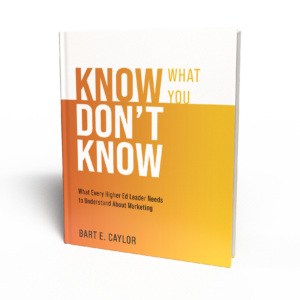 Discover how to:
So you can “trust, but verify” your marketing decisions, avoid costly mistakes, and lead your institution with the strategic clarity and courage needed to thrive in this new era.
Ready to lead with confidence?
Order now!
images via indwes.edu and chatgpt.com


Subscribe to The Higher Ed Marketer podcast today!
Learn how strategic UX and AI-driven website optimization for higher ed can transform your site from a brochure into a high-converting enrollment tool.

Higher ed leadership marketing doesn’t require expertise in every tactic—but it does require asking the right questions.
Leaders don’t need marketing mastery, but they do need higher ed marketing literacy. Learn why “trust, but verify” is critical for your institution’s enrollment strategy.